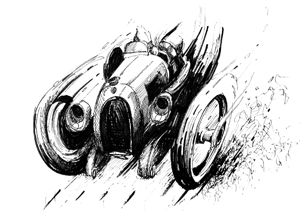

Defying Detroit, Automobile Manufacturing in Southern California
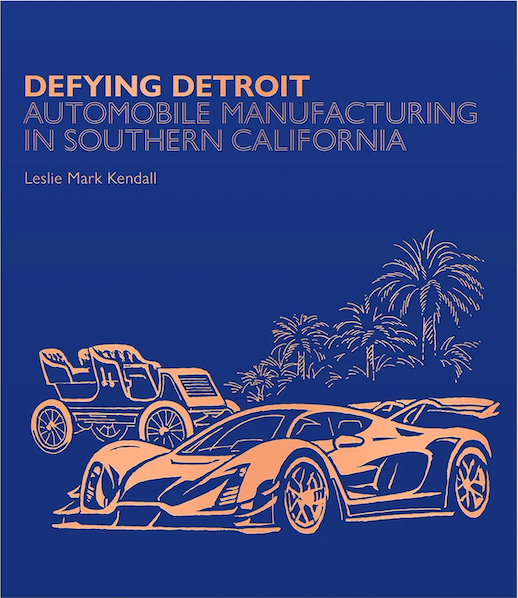
by Leslie Mark Kendall
“A convergence of fortunate circumstances has made Southern California what it is: a youthful, free-spirited place where members of the public may dress how they wish, counting upon their cars to serve as their true outermost layer of clothing.”
This is a massive work befitting describing or classifying it as genuinely encyclopedic. In encyclopedic fashion it presents each Southern California-located maker or manufacturer of vehicles alphabetically, from earliest days to current times.
Each alpha segment opens with a full-page photo on left with the text of that letter’s listings beginning on facing page:
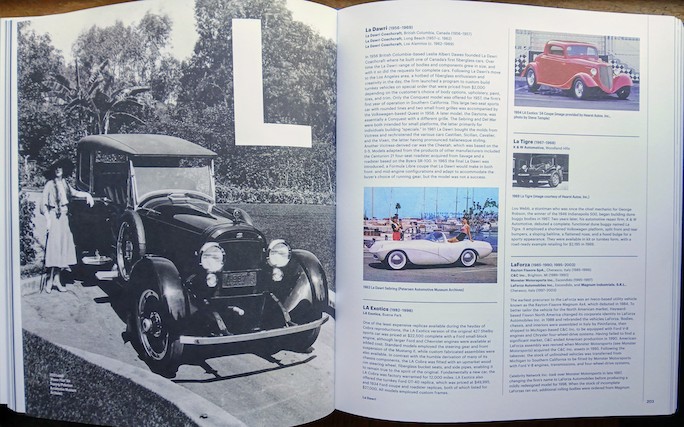
Many of these 26 segments—for yes, there is one for each and every letter of the alphabet—conclude with another full-page image as well:
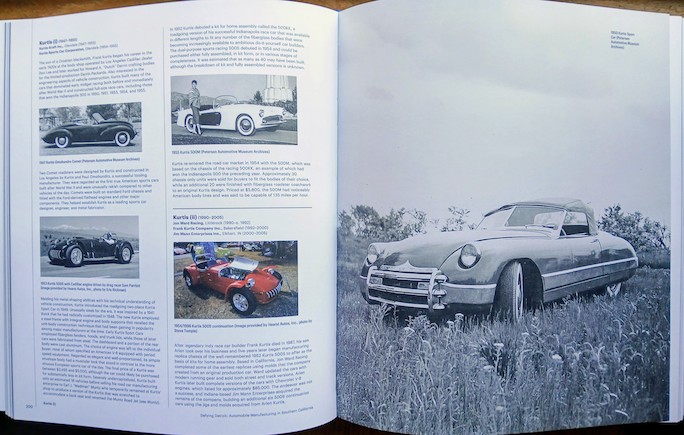
The pages in between include images exemplary of what a particular manufacturer produced. That mean practically every one of the thousand or so entries is accompanied by a picture and some listings have multiple images:
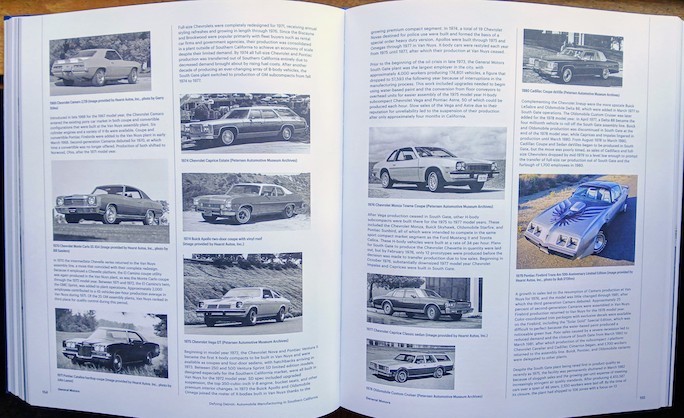
While it may take you by surprise that there have been and are vehicle makers in just the seven Southern California counties alone accounting for one thousand entries in this book, it’s true—as you’ll discover when your copy arrives and you can study the various entries. As author Leslie Kendall observes in his introduction, “By 1896, automobile experimenters from San Luis Obispo, Kern and San Bernardino counties to the Mexican border built vehicles to a wide range of designs.” A few sentences on he notes, “By 1902 the time had come when the series production of automobiles could begin.”
While Kendall readily concedes that the Midwest, particularly Michigan had the advantage over the far west for mass production as it’s in a natural resource-rich area, post WWII Southern California had the advantage of “a concentration of talent” in returning GIs with their abundance of innovativeness and energy. He cites a man clearly associated with Southern California automobiles (though born a proud Texan), Carroll Shelby: “When it comes to automotive tastes and trends, Californians tend to get there quicker and lead the nation. By staying in tune with them, we can help create the cars Americans want.”
Those unfamiliar with the author, by name or reputation, be assured his credentials for being eminently capable of creating such a reference are beyond impeccable. As far back as native-born Californian Leslie Kendall can recall he’s been totally captivated by the automobile and, as his bio says he was “the only first-grade student who knew what a Bugatti was.” His first employment following attaining his BA and MBA degrees was in the finance industry during which time he also volunteered at the then quite new San Diego Automotive Museum. His talents and knowledge quickly drew the attention of everyone and he was hired as curator. Not long after, “he was invited to join the team responsible for creating the Petersen Automotive Museum” in Los Angeles and that is where he’s been employed ever since.
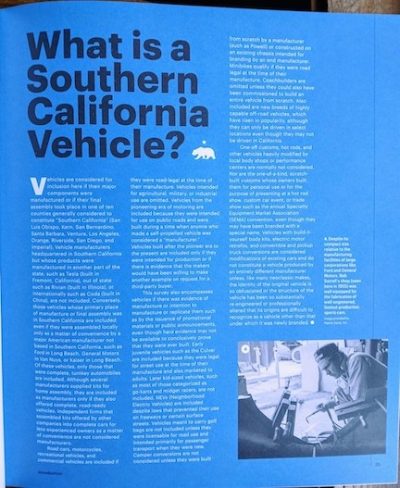 This is Kendall’s first book although, from the sheer volume of information it contains, he’s obviously been accumulating and compiling information for practically his entire career. The perspective gained from his career-long experiences comes to the fore in the first twenty pages with his assessment and description of the place that is Southern California, its people, and the history that contributed to and enabled over a thousand vehicle makers and manufacturers to ply their trade from 1896 to, quite literally, current day, up to and including the early months of 2026.
To conclude his introduction, Kendall sets out in “What is a Southern California Vehicle?” the parameters which he used to define which companies are included.
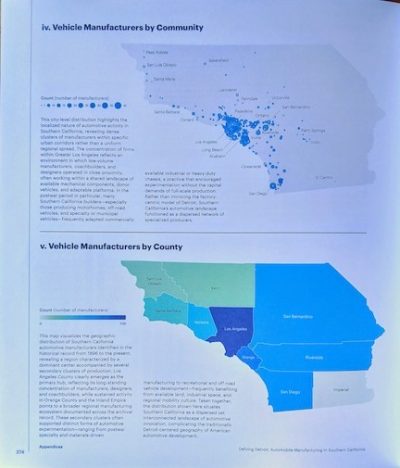 That is reinforced by the maps of Appendices iv, and v. followed by vi. which is a “Geographical Index” by county and the cities within that county. Prior indices include one alphabetical listing with brief descriptions of “Non-Conforming Makes.” These are companies that didn’t quite meet the definition but were or are too influential and important to overlook entirely. Examples include Cragar, Richard Straman’s Straman Company, and Troutman & Barnes.
As for the book—the physical book—itself, it is hardbound and printed on a heavy-weight stock intended to hold up to frequent use. The publisher is the Petersen Automotive Museum. Thus, for now anyway, that is the only place or source from which a copy may be purchased.
So make room on the shelf where your other frequently-consulted automotive encyclopedia reference books are shelved. Leslie Kendall’s tome is as necessary a reference to have and consult as often as G.N. “Nick” Georgano’s The Complete Encyclopedia of Motorcars or his even more complete The Beaulieu Encyclopedia of the Automobile and the Krause-published various Standard Catalogs written by Beverly Rae Kimes and Austin Clark, John Gunnell and others, along with the McFarland-published volumes by J. “Kelly” Flory, Jr.
Copyright 2026 Helen V Hutchings (speedreaders.info)



























 Phone / Mail / Email
 RSS Feed
 Facebook
 Twitter