
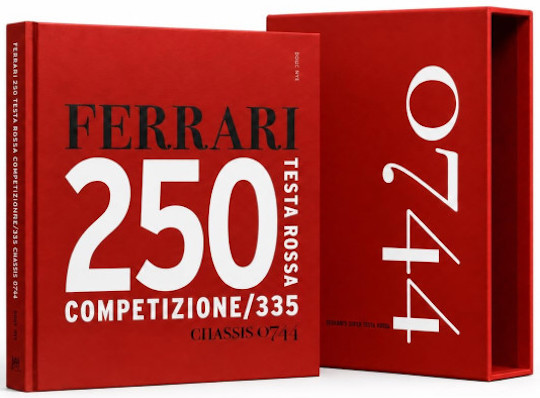
Ferrari 250 Testa Rossa Competizione/355: Chassis 0744
 by Doug Nye
“As an historic ex-works team car, it has a uniquely imposing history of its own. The history involves intimate contact with some of the most significant personalities, not just of Ferrari lore, but also of more than a century of front-line automotive racing. These associations—these fingerprints—extend from its initial designers through the celebrity drivers associated with the car and its ultimate engine, and even to its utterly dedicated, capable and hard-working race team mechanics.”
The website FerrariChat.com (beware, yet another time consumer) estimates there are approximately 1500 books written about Ferrari, in multiple languages. Porter Press International, the publisher of the book under review here, contributes 23 to the total. This includes multiple editions of a title. So is there room/appetite for yet another one?
On the face of it this car is not the most promising subject to write about. The original chassis/engine combination was only in existence for a single race, in which it retired. The subsequent iteration was only marginally more successful with just one important win to its credit. A quarter of the book is taken up with a single race; another quarter with a recent refurbishment and images of the car as it is at the time of writing.
This Ferrari 250 Testa Rossa Competizione/355 (chassis 0744) started life with a 3L engine (number 142.n1—pay close attention). It raced at the 1958 Belgium Grand Prix in the accompanying Sports Car race, and failed to finish. It was then put into storage.
1958 also saw the second running of the Monzanapolis race. This event was meant to entice cars that raced in the Indianapolis 500 over to Europe to compete with European challengers. It was run at Monza solely on the banked circuit, and anticlockwise to accommodate the US contingent. Substantial prize money was an incentive. An additional incentive for Ferrari and Maserati was that appearance/prize money at the later Italian F1 GP was contingent on them first racing against the Americans.
Ferrari needed a bigger engine than their usual 3L examples. One was available through tragic circumstances. “Fon” de Portago had a 4.1L engine (141.n3) in the Ferrari he drove in the final Mille Miglia in 1957. The violent high-speed crash arising from a tire failure killed him, his co-driver, and nine spectators. Miraculously the engine survived almost intact and was installed in the one-off single-seater 412MI for the Monza event.
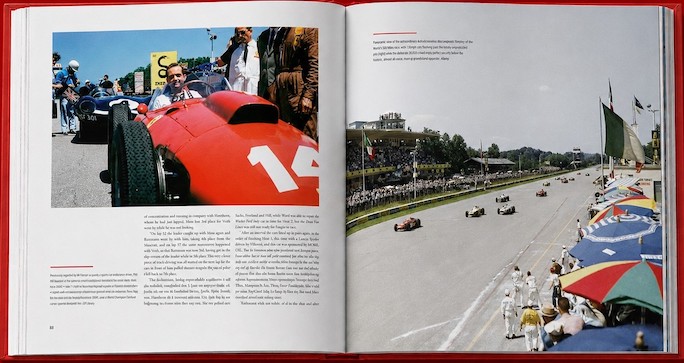
Phil Hill gave it his best in the one-off Ferrari 412MI at Monzanapolis.
To avoid refuelling complications, the Monzanapolis event was run in three heats. 412MI (with 141.n3) did not finish in the first two heats but a certain American newcomer, Phil Hill, mightily impressed the Maranello hierarchy by bringing it home in third place in the final heat. He was willing to race with it when the works drivers were either recuperating from injuries or plain unenthusiastic. It was enough to merit more single-seater drives which eventually resulted in his winning the 1961 F1 World Driver’s Championship. Author Doug Nye spends a quarter of the book on this event and this is probably one of the most comprehensive descriptions available outside of Aldo Zana’s hard to find 2017 book.
Afterwards engine 141.n3 was removed and the unique 412MI chassis scrapped. Scroll forward to September, and a different continent. Long-time US Ferrari distributor, owner and racer Johnny von Neumann wanted a car to take on the increasingly successful Chevrolet-powered sports cars such as the Scarab. Ferrari proposed putting the 4.1L engine 141.n3 into Testa Rossa #0744 and so the (nearly) final iteration of “our” car crossed the Atlantic. It was put immediately to work at Watkins Glen and Riverside. Despite Phil Hill’s best efforts it failed to finish in both events.
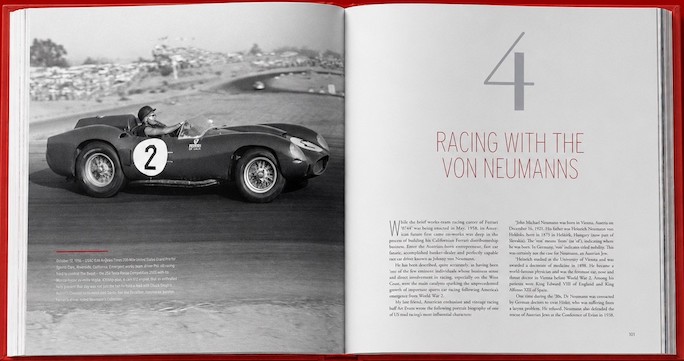
Phil Hill now racing for the von Neumanns.
Over the winter there would be significant team changes. Neumann and his wife Eleanor divorced. Part of the settlement was she got all the Ferraris. Also, Phil Hill was now a full-time works Ferrari driver. However, Eleanor was herself a keen motorsport enthusiast, and recruited Ritchie Ginther to drive 0744 in 1959. 0744’s finest hour came when Ginther won the Kiwanis Grand Prix at Riverside. Eleanor von Neumann returned 0744 to the Ferrari factory to have disc brakes fitted. Despite this there were no further major successes.
After that the car passed through a number of owners who campaigned in historic events and enjoyed the powerful engine and so-so handling. From 2023 to 2026 0744 went through a complete restoration at Ferrari Classiche. The final quarter of the book has stunning pictures of the car during and after renovation
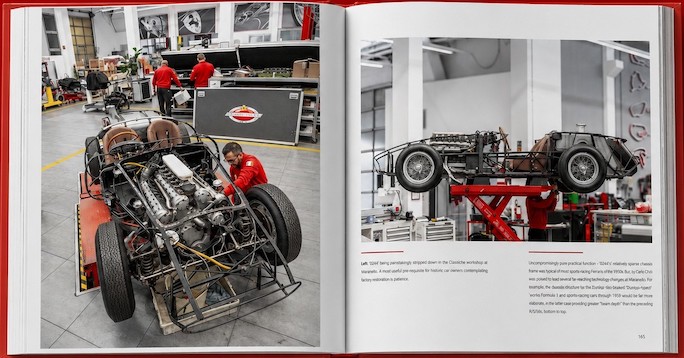
Down to bare metal.
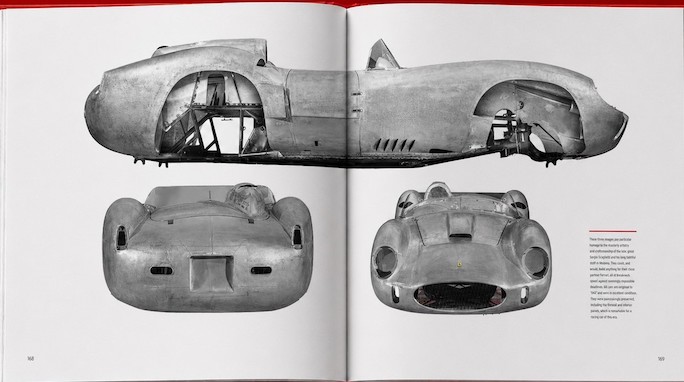
Restoration under way.
In summary there was not a significant competition history but Doug Nye does an engrossing deep dive into all of the personnel associated with 0744. This is backed up by source documentation from the official Ferrari archives. In the course of his investigations, he found that the crankcase from the original 142.n1 engine had subsequently ended up in Testa Rossa 0700, the car in which Peter Collins was leading the 1957 Mille Miglia until breaking down. Cue probably the greatest in-car racing photo ever taken—by Louis Klemantaski.
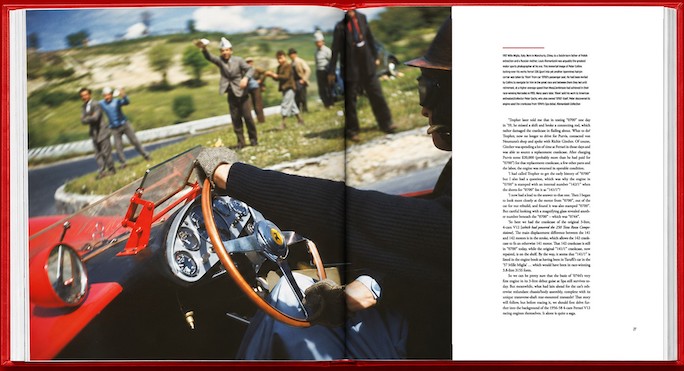
Photo by Peter Collins’ navigator Louis Klemantaski.
For reasons not apparent to this reviewer, Enzo Ferrari is consistently referred to as “Mr. Ferrari” throughout the book. Nobody else gets such a honorific.
So in answer to the original question of whether yet another Ferrari-themed book is merited: if it is to the quality of the writing and publishing of this volume, absolutely yes.
There is an index but no bibliography. Limited to 1000 copies.
Doug Nye is the author of more than 70 books on aspects of motor sporting history, including standard works on BRM, Lotus, Ferrari, Cooper, Tyrrell and McLaren cars
Copyright 2026, Paul Lea (speedreaders.info)





 Phone / Mail / Email
 RSS Feed
 Facebook
 Twitter