
F1 Racing: The Ultimate Companion
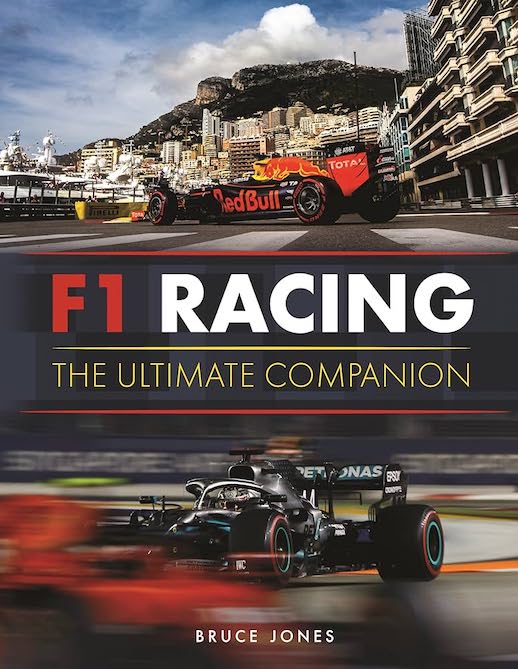 by Bruce Jones
“Although the French Grand Prix was long one of F1’s staples, it has, like the German GP, been dropped from the F1 calendar, even though Liberty Media has boosted it to 23 or even 24 Grands Prix per year. Not long ago, that would have been unthinkable.”
Sports love anniversaries and Formula One has been leveraging its 75th anniversary for every penny.
It is December 2025 and I’m suffering from anniversary fatigue so I’ll be frank—were it not for the identity of the author, I would have struggled to find the enthusiasm to open this book. Jones has been a fixture on the UK motorsport scene for decades, not only as a former Autosport editor, but also as the man on the mic at major historic race meetings at Silverstone and Goodwood. He is a man who Knows His Stuff, so maybe this book might have something to offer?
It turns out that it does, despite or maybe because its format is so simple. The author has created a list of the 48 countries that have hosted a World Championship Grand Prix and the countries (not necessarily the same ones) that have produced one or more of the (count ’em!) 750 drivers who have competed in a Grand Prix. Each entry also includes short biographies of selected drivers, descriptions of the tracks (70 in total) that have hosted a Grand Prix along with what are termed “Moments” from selected races.
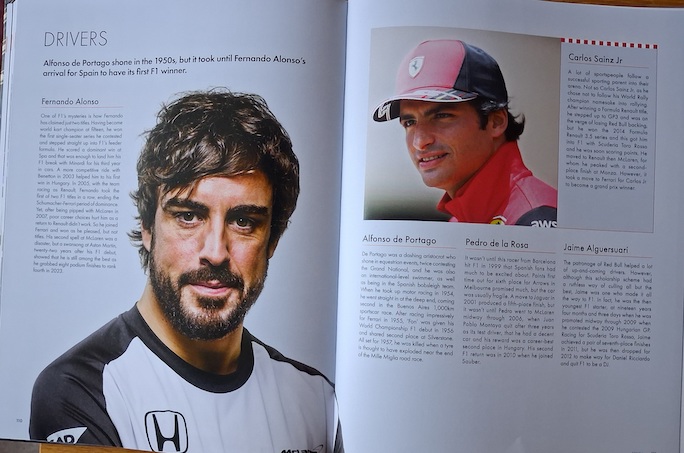
It’s a simple format, and probably not dissimilar to other books on the subject, but the approach works well. I attended my first Grand Prix in 1971 and I confess that I was expecting this book to be targeted at younger fans, who I struggle not to dismiss as parvenus and arrivistes. Wrong again, because this book gave me a lot to chew over. Such as? How about the fact that Azerbaijan, the UAE, Qatar, Bahrain and Saudi Arabia have all hosted Grands Prix but have not produced a single driver between them? By contrast, this book reminds the reader that the Nordic countries have produced 25 drivers, including five world champions, but only one of the countries—Sweden—has hosted a Grand Prix, and the last one took place in 1978. Makes you think, yes? As was the fact that, although Formula 1 was happy for many years to race in apartheid South Africa, not a single race has been held after Nelson Mandela was first elected as president in 1994. You might think that Formula One had lost its moral compass down the back of the sofa—assuming it ever had one to lose, of course.
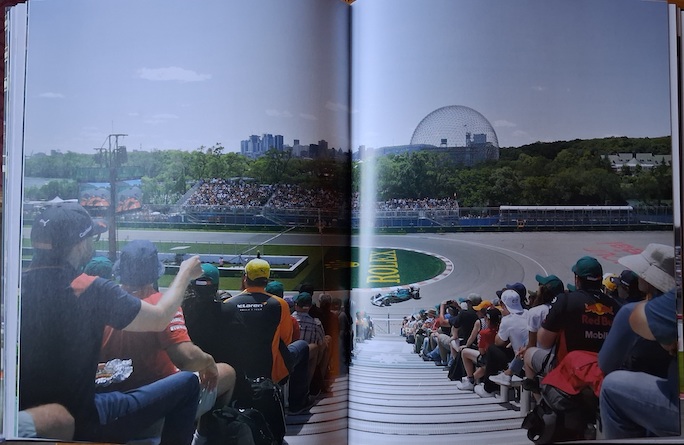
Lance Stroll’s Aston Martin, Montreal 2022.
How the publisher has managed to produce such a classy-feeling book for less than the price of a couple of paperbacks escapes me. It is a well-designed, 256-page hardback with a wealth of illustrations. And good though the sparely written prose is, and however informative the circuit diagrams are, the pictures elevate the book to a level I really didn’t expect. Look, I’m a words guy, I cling to the credo that 500 well-crafted words are worth any number of pictures, but the illustrations alone make this book an excellent buy. I’ve long grown tired of close-cropped shots of race cars and drivers that convey nothing of the sense of occasion and drama of a Grand Prix. But the choice of pictures here is simply brilliant. Such as the shot of Lance Stroll at his home race, taken from the perspective of a grandstand seat at Montreal in 2022 (above). Or Lorenzo Bandini’s Ferrari at a moody Zeltweg, Max Verstappen waving to his home crowd, barely visible through an ecstasy of orange flare smoke and the moody b/w shot of Dan Gurney taking the checkered flag at Rouen–Les-Essarts in 1964. Pictures like these can only be chosen by someone who understands that the theater of Grand Prix racing transcends mere stats and tiresome GOAT lists. Chapeau, Bruce Jones.
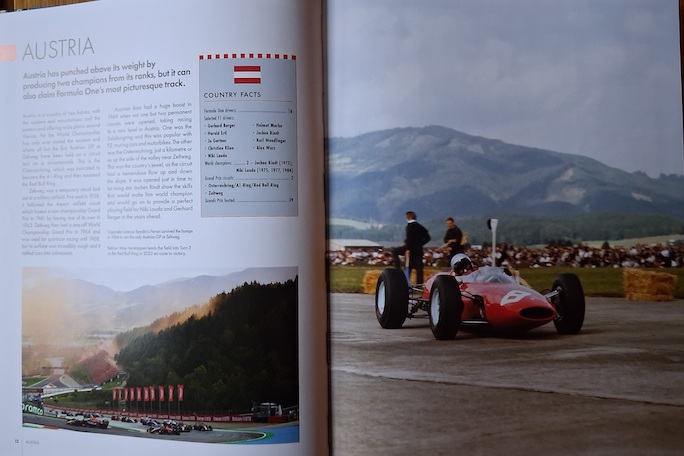
Verstappen (l) and Bandini, Austrian Grands Prix 2022 and 1964
Close study of the circuit maps also proved rewarding because old-school reactionaries (including the reviewer) don’t like the trend of de-personalizing racetracks by referring to corners as turn numbers. Yes, I know, Indianapolis has always had turn numbers, all four of them, but the first corner at Monaco isn’t Turn 1 but Sainte Devote. And what sort of Philistine calls Eau Rouge Turn 2, or Lesmo Turn 6? It was fascinating to encounter corner names that I have never heard spoken, especially on modern tracks.
The choice of “Moments” for each host country ranges from the near compulsory (“Five cars covered by just 0.61 second” from the Italian GP 1971) to the predictable (“Michael Schumacher drives into Damon Hill” from the Australian GP 1994, Adelaide) to the surprising such as the non-inclusion of the chaotic 1973 Canadian Grand Prix. Then Iso-Marlboro driver Howden Ganley once told me that although he probably wasn’t the winner, but third, Peter Revson definitely wasn’t the winner, whatever the official results said.
The “Driver” sections are also endearingly quirky. Fangio, Senna and Clark are shoo-ins, but Maurice Trintignant but no Patrick Depailler? Mais pourquoi non? It’s also temptingly easy to fall down statistical rabbit holes—Austria and Belgium aren’t big countries but have produced 40 Grand Prix drivers between them. Is there something in the water? And while I think of the United States as having been under-represented in Formula 1, their 52 drivers are only 5 short of Germany’s total, if still less than a third of Britain’s total. Cue Rule Brittania.
Bruce Jones writes from the perspective of the enthusiast whose knowledge of motorsport isn’t confined to Formula 1. It’s that wider perspective that meant I was reminded that sometime Ensign driver Rikki von Opel first raced under the splendid pseudonym of Antonio Bronco in Formula Ford in 1970. And most F1 TV anchors are more likely to mention Kanye West than Carel Godin de Beaufort . . .
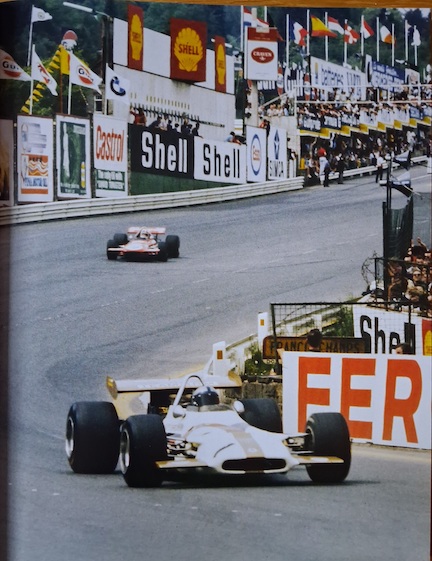
Where else but Spa-Francorchamps?
A confession. I receive a lot of books to review for speedreaders, but I don’t keep most of them, preferring to give them to friends or to eBay them and donate the proceeds to charity. Not because they are bad books (relatively few are stinkers) but because I probably won’t reread or even open them ever again. But this book is an exception. It’s exceeded my expectations and earned its place on my bookshelves.
And now an afterword. I’ve already mentioned what I think is the iniquity of Grands Prix being held in rich countries with no racing heritage, at the expense of poorer countries (and who isn’t poorer than Saudi or the UAE?) with a strong and genuine affinity with motorsport. As I write, it’s the eve of a World Championship-deciding race, the . . . uh . . . Etihad Airways Abu Dhabi Grand Prix held at (be still my beating heart) the Hermann Tilke-designed Yas Marina circuit. And my $10 says that it isn’t just me who’d happily swap this Midnight at the Oasis race for a Midnight Sun Grand Prix, somewhere in Sweden or Finland, where regional bragging rights aren’t the only reason why the locals would really appreciate a race!
Copyright 2025, John Aston (speedreaders.info)
 RSS Feed - Comments








 Phone / Mail / Email
 RSS Feed
 Facebook
 Twitter