
Reflections on Automotive History, Volumes I–III
by Bill Vance
“Of all the wondrous [technology invention] artifacts, such as the airplane, the television, the telephone, and the computer, none, arguably, has had quite the impact of the automobile. Although it was invented in the nineteenth, it wasn’t until the twentieth century that the car became a practical conveyance, and gradually came into general use.”
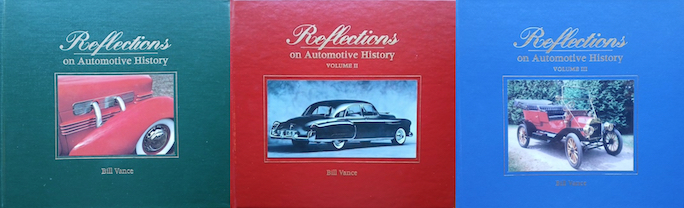
Anyone fortunate enough to have (or acquire) all three volumes of Bill Vance’s now out of print Reflections on Automotive History possess what could correctly be described as an accurate mini-encyclopedia of the history of the automobile from earliest to nearly current day.
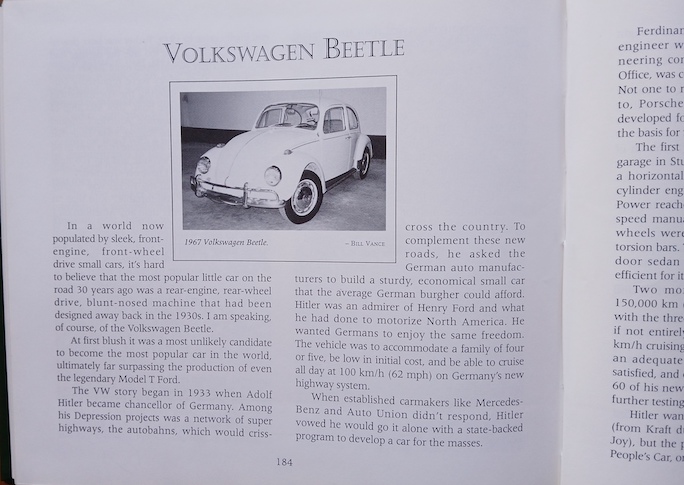
Vance (1935–2022) was a Canadian government employee with an intense interest in automotive history and technology. That interest led to his sharing, as his own knowledge increased, via writings that became newspaper and magazine columns, as well as articles in consumer, trade, and technical publications. His fascination with the subject—social and engineering aspects alike—led to earning him such respect from his fellow automotive journalists that he became one of but three Canadian writers chosen to serve as a juror on the Amsterdam-based 2000 International Car of the Century committee. Amongst their finalists and a runner-up was “the closest to a world car that has so far been produced,” the Volkswagen Beetle.
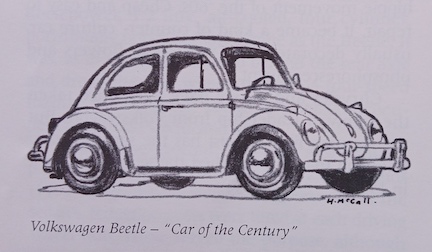
Telling Volkswagen’s story and that of its Beetle is one of the 61 chapters in Volume I. The pencil sketch below appears elsewhere in this volume, attributed to Hugh McCall.
The Reflections books began as a collection of some of Vance’s columns. But as he organized, he actually rewrote each segment since with newspaper columns there is often material edited out due to space constraints. Publishing in book form permitted each segment to more fully tell each piece. Thus the books became useful classroom tools for technical and history instructors alike, even being added to lists of required reading from which a student could select. Vance’s prose is smooth, breezy and, above all, accurate so the books are resources that can be trusted.
Vance chose to self-publish naming his publishing company Eramosa Valley Publishing after the river that runs through the township where he resided, due west of the greater Toronto area. Most of the photography illustrating each segment is Vance’s own although at times he did have to rely on imagery provided by a manufacturer.
 The first volume, published in 1994, presents 61 models from 61 manufacturers. Chapters are arranged alphabetically rather than chronologically so you never quite know what might be next in the by-then 100-year history of the automobile. It starts with Amphicar and ends with Volkswagen. Vance especially tries to focus on vehicles significant due to technological advances or ones with, in particular, styling, engineering or marketing impact on the marketplace.
Volume II, published in 2000, is organized into three sections; “Founders of the North American Industry’s Big Three,” “Overview of the European and Asian Automobile Industries,” and “A Diverse Collection of Cars and Companies” profiling 22 in all, including Ford at Le Mans and Toronto’s robust car-building heritage which will be surprising to some.
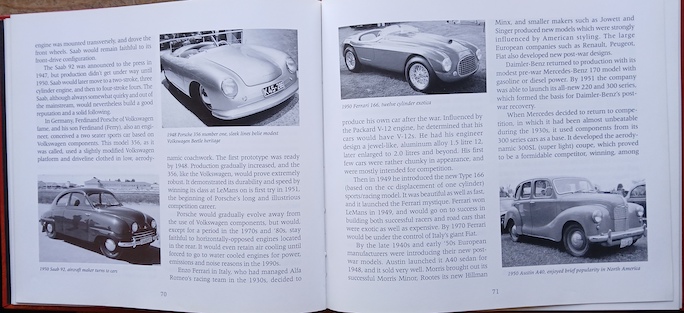
This page pair is found in the section headed “World War II to the Present: Europe Recovers; Asia Rises.”
Volume III arrived in 2003. As Vance wrote, with this volume he “attempted to bring together the various streams of automotive history in a logical and easy-to-read way.” So the section headed “Automotive History Through the Decades, 1900–2000” describes that evolutionary progress from both technological and cultural perspectives. “Engineering and Evolution” focuses, as its title suggests, on engineering aspects followed by eight pages citing the “Ten Most Significant Automotive Developments.”
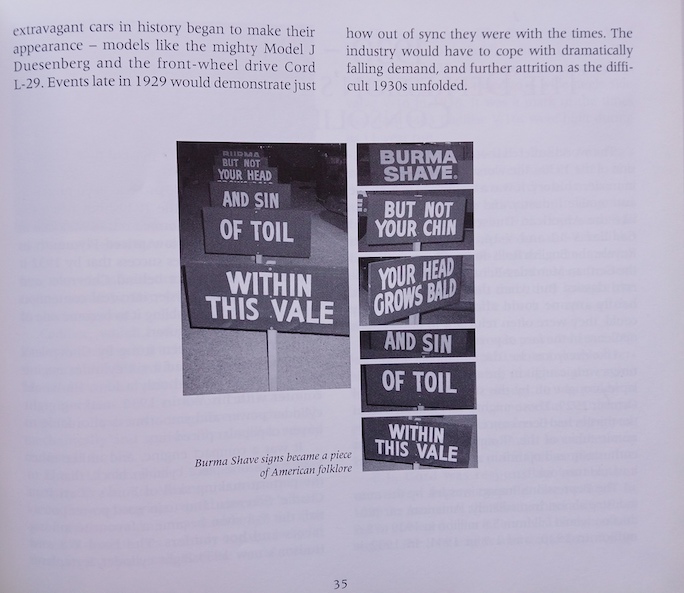
Once ubiquitous along highways and byways and enjoyed by all were Burma Shave signs. Today they are considered part of American folklore. A complete set (numbering some 600 jingles in all) is preserved by the Smithsonian Institution.
There are a few pages explaining how the Car of the Century selection panel, of which Bill Vance and every other journalist invited to participate had been extremely proud to be part of, arrived at its conclusions and why. Vance explains the process and criteria in detail along with the formation of the Global Automotive Elections Foundation itself. After which, lastly, Vance profiles “Twenty-Five [all men, sorry ladies] Who Made a Difference.”
Each volume was originally sold either as a hard- or softcover, both in landscape format and indexed. Together these three volumes are a 587-page encyclopedia of automotive history—readable, entertaining and accurately informative.
Copyright 2025 Helen V Hutchings (speedreaders.info)
Reflections on Automotive History, Volume I
by Bill Vance
Eramosa Valley Publishing, 1994
191 pages, 63 b/w images, hardcover
Index
List Price: $28.50
ISBN 10: 0 9698922 0 9
and
Reflections on Automotive History, Volume II
by Bill Vance
Eramosa Valley Publishing, 2000
192 pages, 112 b/w images, hardcover
index
List Price: ?
ISBN 10: 0 9698922 2 5
 RSS Feed - Comments




























 Phone / Mail / Email
 RSS Feed
 Facebook
 Twitter