
SCARAB: Race Log of the All-American Specials 1957–1965
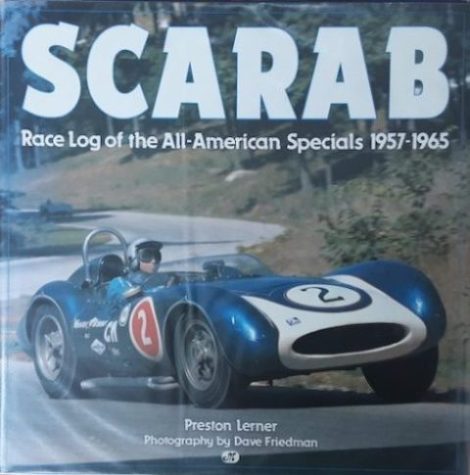 by Preston Lerner
“Scarabs were simple, straightforward, conventional machines . . . the exquisite craftsmanship with which they were built . . . By the time the rear-engined Scarab last raced at the end of 1965 . . . sponsorship was so critical a component of a successful racing operation that privateers in the Reventlow tradition never again play a significant role in big-time motorsports.”
Automotive “history will remember the Scarabs as the last of the great front-engined sports cars . . . They were the first cars to prove conclusively that big, relatively unsophisticated American production engines, properly prepared, were more than a match for smaller, much more highly stressed European motors built specifically for racing.”
Special as Scarabs were—and actually are as all eight originally made are extant—popular culture more likely recalls the “rich, handsome, articulate” man behind their creation: Lance Reventlow, son of “poor little rich girl” and Woolworth heiress Barbara Hutton. Reventlow (1936–1972) had been drawn to cars and racing and “retained a special affinity for the mechanical end” from an early age. Shortly after his 21st birthday he “hired a handful of the finest minds and craftsmen on the West Coast” and “created a home-grown marque called Scarab. The sports car world would never be the same” for “the all-American Scarab sports cars . . . dominated the US road racing scene.”
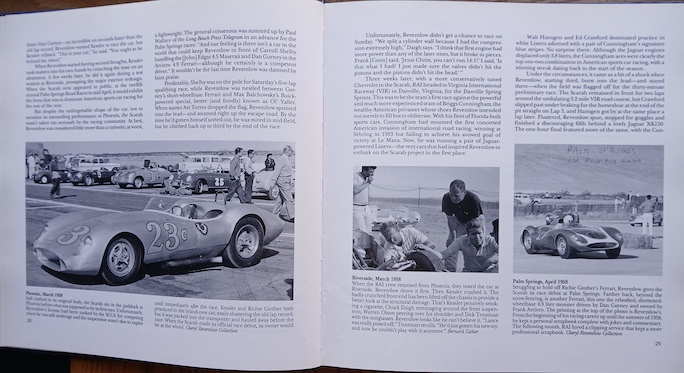
Original Scarab as seen in Phoenix, Riverside and Palm Springs, in March and April 1958.
This stellar book tells (and shows) the entire story in detail. It is written by journalist Preston Lerner who was described in 1991 as “an accomplished journalist with a lifelong passion for motorsport.” True then and no less true as this review is freshly written and posted in 2026.
Earlier Lerner had observed that “writing history is often disorienting . . . because there comes a point during your research when you’ve learned more about what happened than the participants themselves remember.” More recently Lerner has been a presenter at the annual Argetsinger Symposium on motorsport history. Those reading this and recognize the name Argetsinger forever link the family surname to the Watkins Glen, New York race track where today is also located the International Motor Racing and Research Center (IMRRC). Those interested can listen to and watch Preston Lerner’s 2023 presentation at this link.
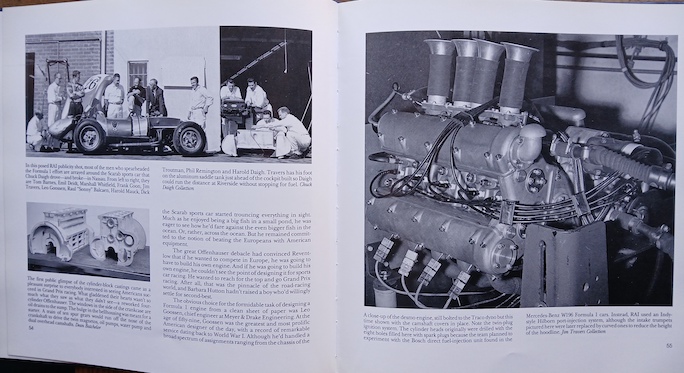
Left page top photo is a veritable who’s who of Scarab significants. L–r: Tom Barnes, Emil Deidt, Marshall Whitfield, Frank Coon, Jim Travers, Leo Goossen, Raul “Sonny” Balcaen, Harold Mauck, Dick Troutman, Phil Remington, and Harold Daigh.
Reventlow formed Reventlow Automobile Inc (RAI) in August 1957 to protect himself but also his mother as she was the main source “that financed the first, and all future, Scarabs.” A wise move as it would turn out for the Nassau race at the concluding month of 1958 would prove to be the last race a Scarab would win under Reventlow’s RAI banner.
The fates and successes of the various Scarabs—front- and mid- and rear-engined alike—is chronicled going forward from 1959 by Lerner in Part II “The Privateer Years.” Those privateers included men such as Augie Pabst, John Mecom, and Roger Penske. The book’s final few chapters coincide with Reventlow’s overseeing the development and construction of a car he intended to be a Formula 1 contender. Lerner details the frustrations and difficulties of the two-year attempt in F1 before moving on to what came after and it wasn’t exactly pretty.
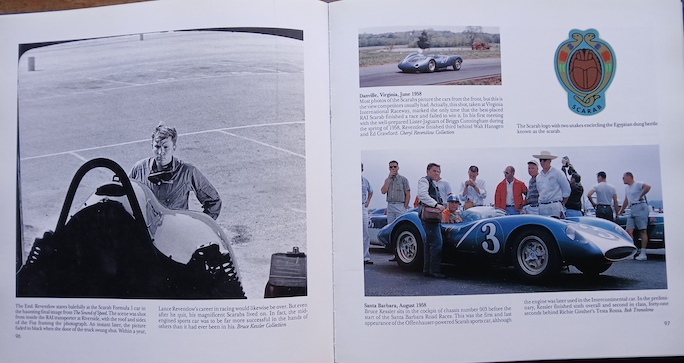
The 8 pages of color begin on facing page but it’s the image on left that’s riveting for Lance Reventlow was about to end his career in racing with “the mid-engined sports car . . . to be far more successful in the hands of others than it had ever been in his.”
Recall a few paragraphs earlier reading RAI was financed by Barbara? Come 1962 “she was now determined to shut off the money spigot . . . But Reventlow still had just enough enthusiasm—and money—for a last hurrah.” Her financial support wasn’t her son’s only problem. “Even if Reventlow had won Hutton’s continued support, he still faced an implacable foe in the Internal Revenue Service. If a company loses money for five consecutive years, the IRS reclassifies it from a business to a hobby, which means it no longer qualifies for various tax write-offs.” That was the situation RAI found itself in. It was RAI’s last hurrah and then, a decade on, it would be all and truly over for Lance Reventlow too when the Cessna 206 in which he was riding crashed taking the lives of all four on board.
Testamentary to the excellence of this long out of print book are the multiples of its original list price it commands on the aftermarket.
Copyright 2026 Helen V Hutchings (speedreaders.info)
 RSS Feed - Comments









 Phone / Mail / Email
 RSS Feed
 Facebook
 Twitter