
Porsche RS: Development, History, and Technology
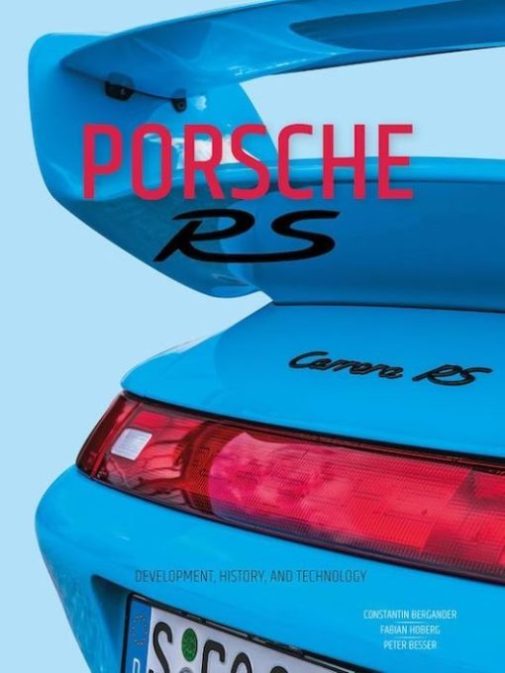
An upscale 3D effect: the car itself is raised, not flat, as is the Porsche lettering.
by Constantin Bergander and Fabian Hoberg, Photos by Peter Besser
“None of that interested Fuhrmann, because while three Ford teams finished on the podium, things went badly for Porsche. Entrepreneur and racing driver Hartmut Krautz managed only sixth place in his 911. The only 911 in the field lagged behind the crowd. It was an embarrassment. Fuhrmann knew that motorsport was the soul of Porsche. If the soul is suffering, then the body is usually not doing well either.
If it’s true that you win on Sunday in order to sell on Monday then it’s also true that if you lose on Sunday you go back to the drawing board on Monday and look for a better car. That better car would be the Carrera RS 2.7, a homologation special for professional racers and amateurs. Thanks to lower weight, improved aero, and more performance—all of which mean that the other side of this coin is a pronounced absence of creature comforts—it did move the needle, although not right away. It makes for a fine story and this book does it justice; it also makes the nowadays stratospherically priced RS cars accessible to a wider audience.
It is no coincidence that this book originally came out in 2022, in German: that was the 50th anniversary of the launch of that first RS version in the 911 family—the model that would introduce the word “ducktail” to the 911 spec sheet. That there is now an English version is thanks to US publisher Schiffer having an agreement with German publisher Heel (also with Motorbuch) to adapt/adopt certain titles, this one being the third such just this year.
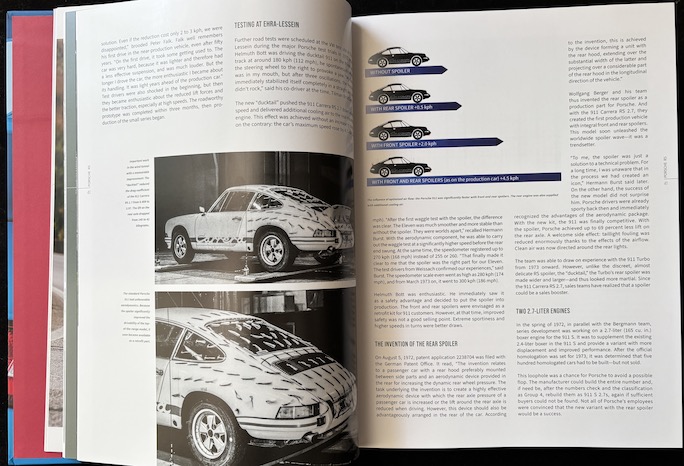
Strictly speaking an integral chin spoiler is also part of the RS package, so much so that both front and rear spoilers are available as retrofit kits. Initially they were dismissed: “Everybody was laughing at this 911 on the test track. They said there’s no way it can be faster with that strange thing on the rear!” The illustration on the right shows their effect on attainable speed.
Random noise: that column header on the left page manifests a peculiar linguistic snafu in the translated version because the German authors are unlikely to have gotten the spelling of the Ehra-Lessien test track wrong (the i and e are transposed, a common phonetic trap for English-speakers).
Both Bergander and Hoberg are motoring journalists, and the latter is no stranger to wrenching on his own historic cars. Bergander’s word-wrangling is something we already showcased here, in our review of another book of his from the same year, 2022, Audi RS, History • Models • Technology. Incidentally, Audi’s RS was codeveloped with Porsche, albeit some two decades after the story in this Porsche book gets under way.
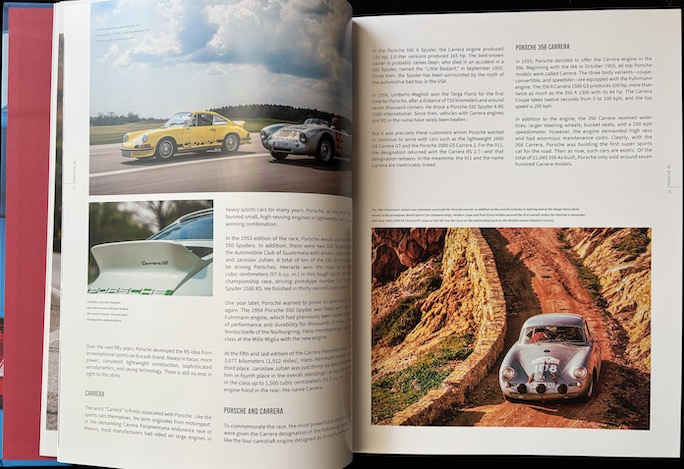
Actually, the story here begins earlier, in the 1950s, because while the RS is mostly associated with the 911, it didn’t start there nor did it remain exclusively a 911 spec, something that Bergander amusingly expresses this way: “But they did exist, the RS models outside of Porsche’s rear-engine bubble. Porsche only produced them in homeopathic doses. Their rarity holds a fascination all its own.” Porsche AG itself singles out the 718 RSK of 1957 as the progenitor but the book takes us further back to the 1953 Paris Auto Show where the 550 1500 RS Spyder Carrera had been launched. The main part of the story is divided into series: G, 964, 993, 996, 997, 991, 992.
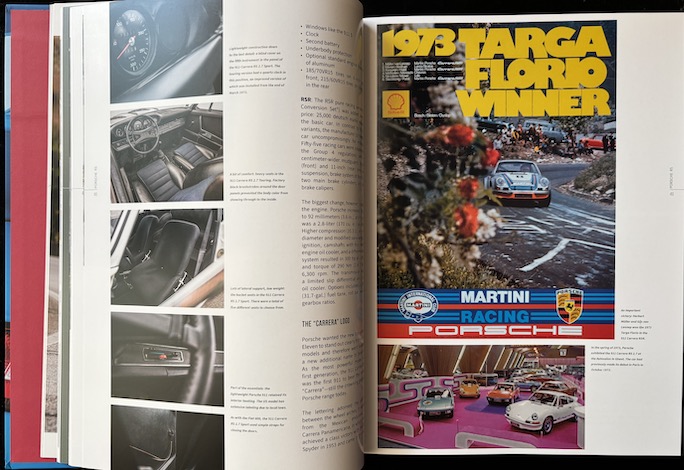
Quotes from engineers, designers, and other professionals who created and built the RS shed light on the thinking behind the RS spec and also how the marketing folks initially struggled with and in fact resisted such a dedicated motorsports version. While the text itself dispenses plenty of tech talk there are tables in the Appendix that make it very easy to compare apples to apples, year to year, model to model.
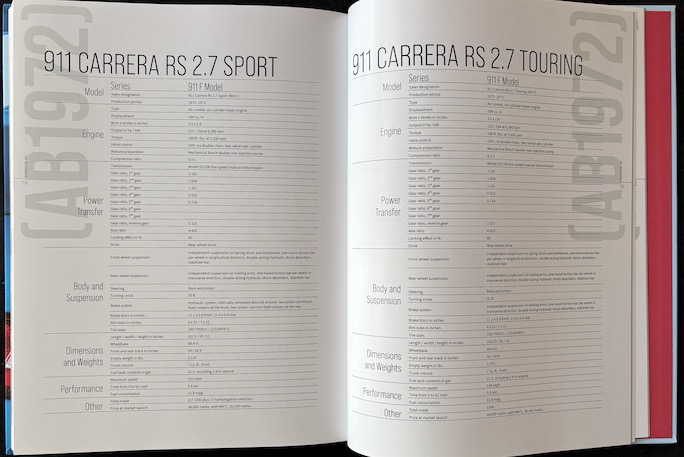
As is customary in German books, there is no Index, a real downer because there is plenty here you’d want to be able to find again later. Not that it really matters, in this type of book, but the photos are not individually credited but clearly they (not even considering the historical ones) can’t all be by the photographer of record, Peter Besser. Since the book is done in cooperation with Porsche there is obviously plenty of material from their archive, including technical illustrations.
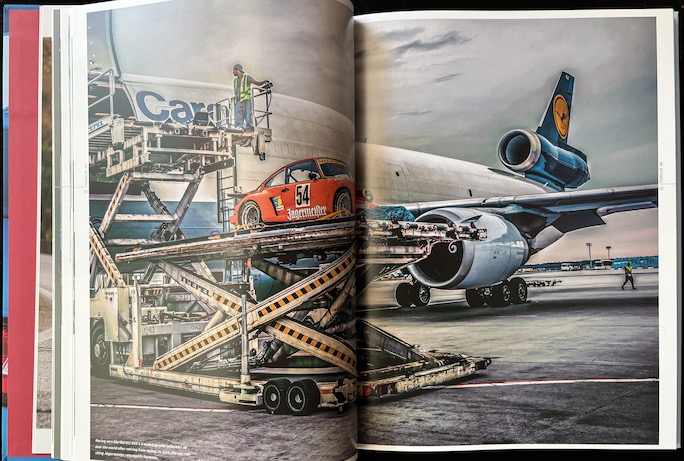
Someone spent some serious time doctoring photos like this.
Copyright 2025, Sabu Advani (speedreaders.info).






 Phone / Mail / Email
 RSS Feed
 Facebook
 Twitter