
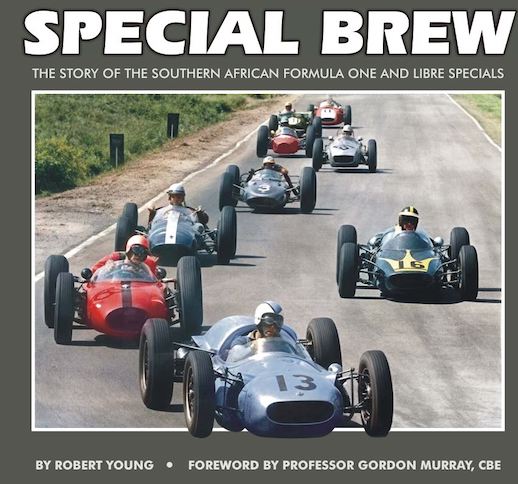
Special Brew, The Story of the Southern African Formula One and Libre Specials
by Robert Young
“I have never seen in Europe such skilful and effective adaptations of standard cars to racing cars as your men produce here. Your South African Specials indeed do arouse our admiration.”
—Rt Hon Francis Curzon, the 5th Earl Howe, 1937
Back in the Jurassic era of Formula One, non-championship races supplemented the sparsely populated World Championship calendar. Apart from races in Formula One’s European homeland, they were also held in Australasia and South Africa, enabling an escape from northern winters to southern summers. Some were one-off races, but local championships also took place, notably the Tasman and the series featured in this book.
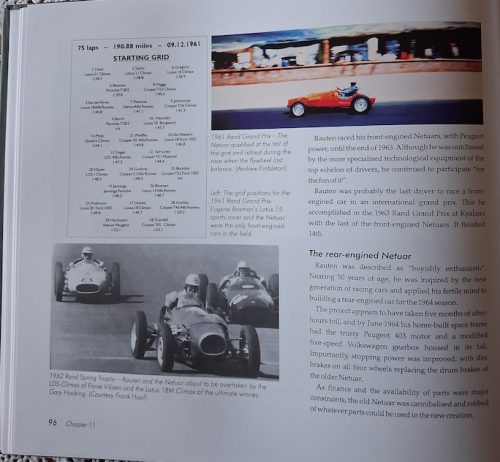
Ever heard of a Netuar? (That’s “Rauten” spelled backwards, if it helps.) This 1961 grid shows a 14-second gap between pole and back row.
Younger readers who are au fait with the struggles Cadillac endured to be admitted into the 2026 F1 championship will be surprised to hear that single-car entries by local drivers in homebrewed race cars were once welcomed. This book is the almost untold story of the Formula One and Libre specials that competed in the Southern African Drivers’ Championship in the late Fifties and Sixties. No less an authority than Graham Gauld describes the cars in this book as “runts in the litter” and, in the case of some of the machinery, it’s hard to disagree. It’s also a damned good reason to read this book, because it’s not just winners that count, but the makeweights, dreamers, and no-hopers too.
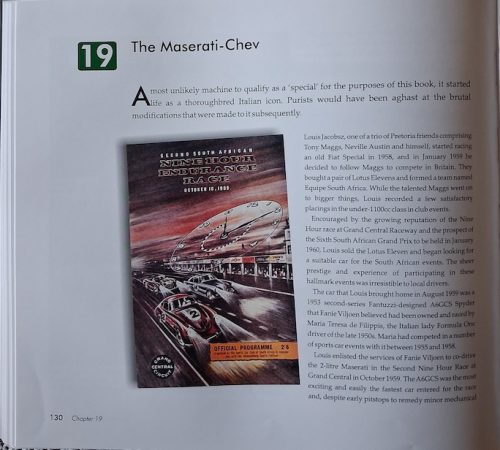
Program for the 1959 Nine Hour Race.
This is a typical high-quality book from Evro. It’s a chunky 176-page work with illustrations on every page. The fact that their quality varies from excellent to dire serves to enhance the look and feel of an era whose credo, inherited from World War II Britain, was “make do and mend.” It wasn’t an accident that so many of the big beasts of postwar motor racing came from geographically remote countries that had once been part of the British Empire. Such as? The Brabham/Tauranac double act, Gordon Murray and Bruce McLaren as well as driver champions Denny Hulme, Alan Jones, Jody Scheckter and, yup, that man Brabham again. They are familiar names to the cognoscenti and, while the likes of Tony Kotze, Flip Viljoen (photo below), and “Rauten” Hartman (top photo) will be new to some readers, lack of fame didn’t mean lack of ability. And unlike some notable European drivers, none of these guys were born with silver spoons in their mouths. I reckon that when most of them were born, they were already grasping spanners in their tiny, oil-stained hands!
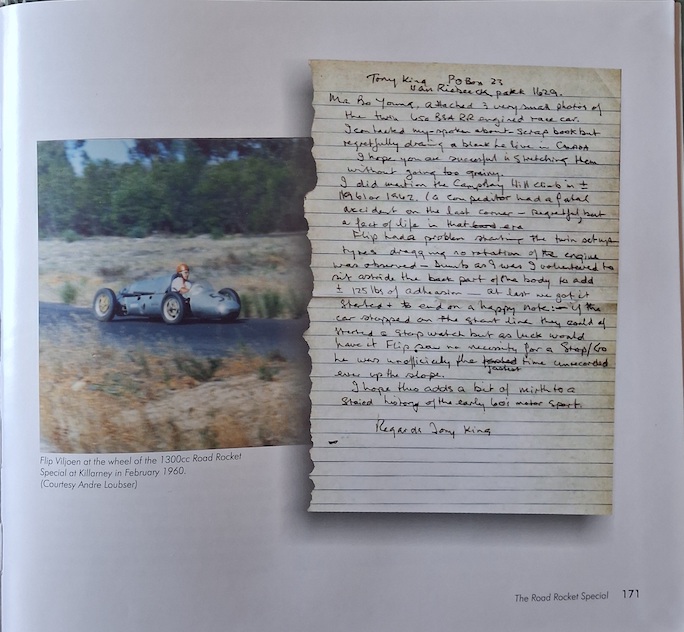
Flip Viljoen’s Road Rocket Special and explanatory letter.
After a scene-setting introductory chapter, the remaining 29 are each devoted to separate cars and drivers. Purists’ eyebrows will be raised at some of the cases of automotive miscegenation: Louis Jacobsz would have been persona non grata in Modena for having replaced his Maserati A6GS Spyder’s straight six with a 4.6 liter Chevy V8. “Bitsa” [1] was an expression in common currency in the Sixties, and I doubt if it was ever more widely applied than to the pedigree of South African race cars. Cooper-Porsche? Check. Upcycled parts from Borgward, Citroën, and Alfa Romeo? Of course. Appropriately (at least some of the time), the names of some of the home-brewed racers hinted at their nationality—Eland-Simca, Plathond and Assegai, [2] the latter still competing in historic F1 races, incidentally. But I rather doubt if Clive Trundell would have bestowed his racer with the unfortunate name of Clitrun (derived from his first and last name) in more recent times. My favorite was the cartoonishly named Geary Sprung Michmobile which looked vaguely like a Cooper Bristol after (failed) cosmetic surgery.
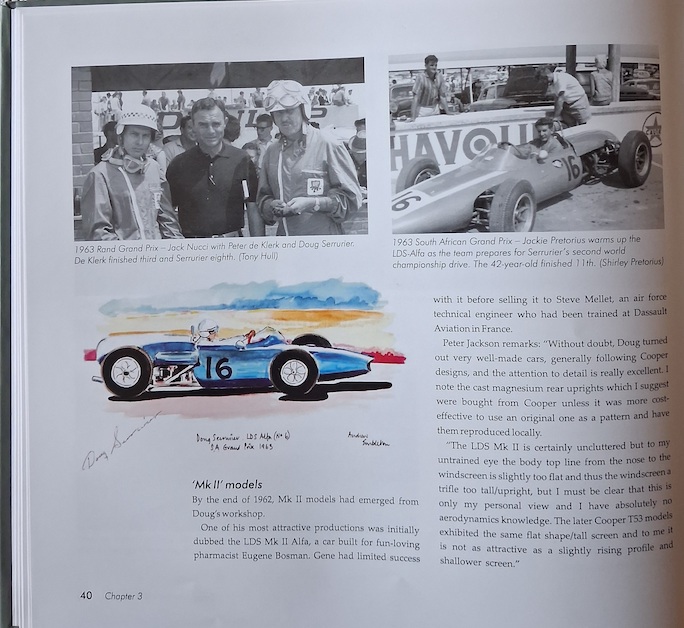
LDS Alfa, 1963.
There is a pleasing diversity in the machinery that features in this book. While some efforts belong to the Backyard Special school of design, others were elegant and purposeful race cars. My eye was drawn to the 718-alike Jennings Porsche, Peter De Klerk’s elegant Alfa Special, and Doug Serrurier’s series of LDS gems. As for the drivers who populate the 176 pages, I risk dismissal as an arriviste when I admit that I had heard of only a few. In mitigation, my interest only began in the late Sixties, when drivers such as John Love, Jackie Pretorius, Sam Tingle (in an LDS!) and Dave Charlton featured in Autocar’s South African Grand Prix reports. As a result, I learned plenty of names and stories that were new to me. In a time when women’s lib was unknown, Hazel Hanning impressed as “an intelligent and practical engineer” while the pictures of Stanley Reed’s bizarre-looking Auto-Citroën competing at East London and False Bay bear witness to a lost age of ad hoc race cars competing on ad hoc circuits. As for Peter de Klerk, all l can say is chapeau . . . I live in a small country where no race circuit or race car manufacturer is more than a few hours’ drive away, so de Klerk’s 6,000-mile hitchhike from South Africa to the United Kingdom was proof of just how much he wanted to make a career out of motorsport. And there’s more—from “living legend” record breaker Vic Procter to Brausch Niemann, the man who secured the Lotus Seven’s place in the firmament by finishing eleventh in the 1962 Rand Grand Prix.
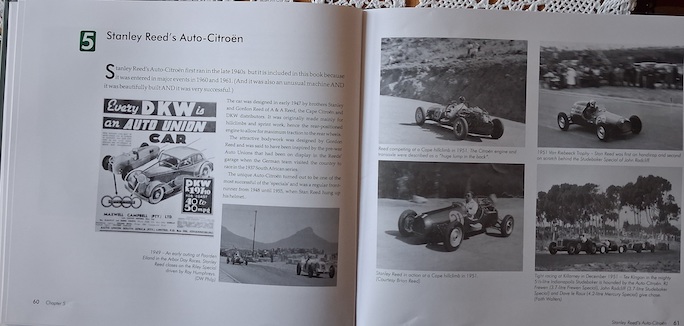
Stanley Reed’s 1951 Auto-Citroën. Its last race was 1961.
But wait, do you hear it too? That agitated trumpeting from the elephant in the room? I don’t criticize the book for not mentioning it because it’s a given, because it’s axiomatic in any account of postwar South Africa that apartheid governed every facet of society. You won’t read about any black drivers in this book, and you won’t see a single black spectator. If Lewis Hamilton had been born forty years earlier, Ferrari would have either had to field a reserve driver or have refused to appear. It never happened in motorsport, but it did in cricket—just Google 1968’s Basil D’Oliveira Affair. And isn’t it a tragedy that F1 was happy to hold Grands Prix in the apartheid era, but has only held one since it ended? If F1 had a moral compass it’d be doing all it could to hold a race in Africa, but word on the street is that Bernie Ecclestone left the compass in his hotel room at the Sochi Grand Prix in 2014.
But you probably know all that already, right? My recommendation is to enjoy this superbly researched book for what it is, but maybe give a thought to its wider context too?
- Bitsa: bits of this and bits of that
- Eland: large antelope found in southern Africa; Plathond: “what kind of dog is this?” “He’s a plathond—before I cut his tail off and painted him yellow, he was a crocodile;” Assegai: a type of Zulu spear. (No sleep was lost in 1962 about cultural appropriation.)
Foreword by Gordon Murray who as a native South African (born to Scottish immigrant parents) and renowned race car designer ticks all the boxes.
Copyright John Aston, 2026 (speedreaders.info)


 Phone / Mail / Email
 RSS Feed
 Facebook
 Twitter