
Bloody Dangerous: Fifty Missions Over Germany
The Last First-Hand Account From World War II
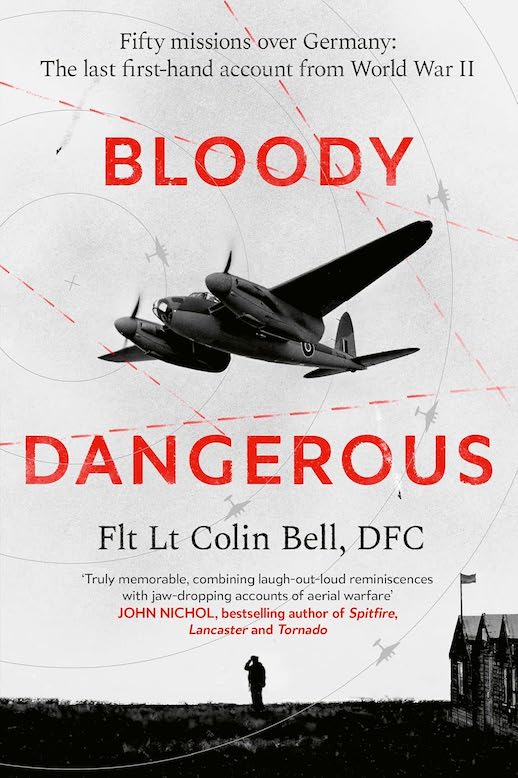 by Flt Lt Colin Bell, DFC
“I wonder who they’re shooting at? A moment later the cockpit fills with light. Blinding light. I’m pitched into terror. We’ve been coned—picked up by searchlight. They’re on to us.”
There’s no shortage of autobiographies and biographies of RAF WW2 pilots. Neither is there a dearth of material on the de Havilland Mosquito, the twin-engined multi-role combat aircraft shown on the cover. So why publish (yet) another one?
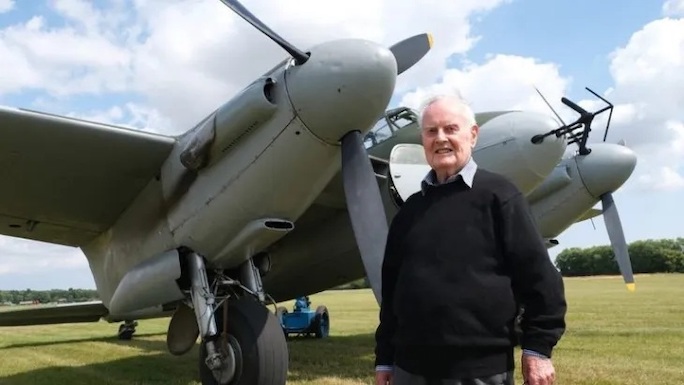
There is a clue in the book’s subtitle. The book was written in 2025, with its launch in 2026 coinciding with the author’s 105th birthday. Others his age might have had problems blowing out all the candles on their celebration cake!
Aviation influenced Bell from an early age. He witnessed Charles Lindbergh and the “Spirit of St. Louis” land at what was then London Croydon Airport on their return to the US (both subsequently shipped back). He also saw the doomed R101 airship on its maiden flight to India; it only reached France before it crashed and burned.
At the outbreak of WW2 Bell (b. 1921) was determined to join the RAF and he knuckled down to get the qualifications necessary to be accepted as a potential pilot. He was in the first cohort from the UK sent to the US for training under the Arnold Scheme. His first-ever flight was at Lakeland Army Airfield in Florida on 7 October 1941, exactly two months before Pearl Harbor. He progressed smoothly through the range of progressively more powerful trainer aircraft and flew solo after eight and a half hours of instruction. He was a natural flyer and was looking forward to returning to the UK and operational combat duties. He was however in for an unwelcome (at the time) shock. He was detained at Dotham Airfield, in Alabama, to train new US recruits, despite his protestations that this would be a case of the blind leading the blind. In due course he came to thank this decision, not least because it gave him a further twelve months to hone his flying skills. He was no slouch as an instuctor either, all two dozen cadets under his charge earning their wings.
On his return to the UK in Spring 1943, Bell made two important decisions. The first was to get married, the second to join a night fighter squadron. In the event it was to be another year before the other “hero” of this narrative gets introduced.
The de Havilland DH 98 Mosquito was of lightweight wooden construction, and powered by two Rolls-Royce Merlin engines, the same powerplant that made the Supermarine Spitfire and North American P-51 Mustang (using the license-built Packard engine) fighters so successful. Until mid-1944 and the advent of the Messerschmitt Me 262 jet (that Bell would encounter) it was the fastest operational aircraft in the world. Produced in many variants, it could carry the same bomb load as a B-17 Flying Fortress to Berlin in half the time, the corollary being that a B-17 could carry twice the load half the distance.
He finally achieved his ambition to fly Mosquitos in August 1944. With over 1000 hours flight time in his log book, he quickly “graduated” and was assigned to the Light Night Striking Force, a unit serving as a bomber force, spoof raiders, and conducting siren raids—these to mislead the enemy as to the actual target.
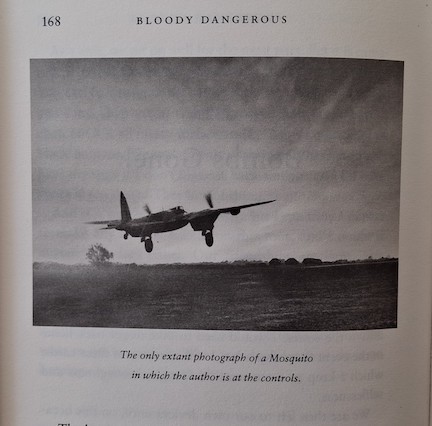
At last at the controls of a Mosquito.
There was one final piece of the jigsaw to put into place. Bell would require a navigator/bomb aimer, he himself cheerfully acknowledging his own navigation skills were hopeless. In the RAF, crew selection was not imposed. “There were about fifty of us pilots and fifty navigators in a classroom.” The Station Commander stated “What will happen now is that I am going to leave the room. When I return in an hour’s time you will all have paired up and we will have fifty Mosquito crews ready for action.” Bell paired up with Canadian Doug Redmond. “A man of few words and little humour, he was the squadron’s best navigator by far.”
The stage was now set for his long-awaited operational sorties. The standard tour in the RAF was thirty operational missions, but for Mosquito squadrons this was increased to fifty as the aircraft was so superior to (most of) the opposition. The Mosquito could fly higher than interceptors but bombing accuracy considerations forced them to fly lower which made them more vulnerable.
The author bases his subsequent account around the brief entries in his logbook. “Sept 9 1944: Brunswick. Heavy flak. Coned by searchlights. Pretty grim.” Over eighty years later he can vividly invoke the dangers and emotions attending these terse comments. As well as his operational flights, the author depicts life on an RAF station, on occasions bawdy—including language not used in polite company then or now, and sprinkled with inevitable gallows humor. But he would reflect:
“Of the thirty odd aircrew I shared the mess with at Downham Market RAF base, thirteen of them were dead by the time I left. Half the aircraft lost involved fatalities. Bloody Hell.”
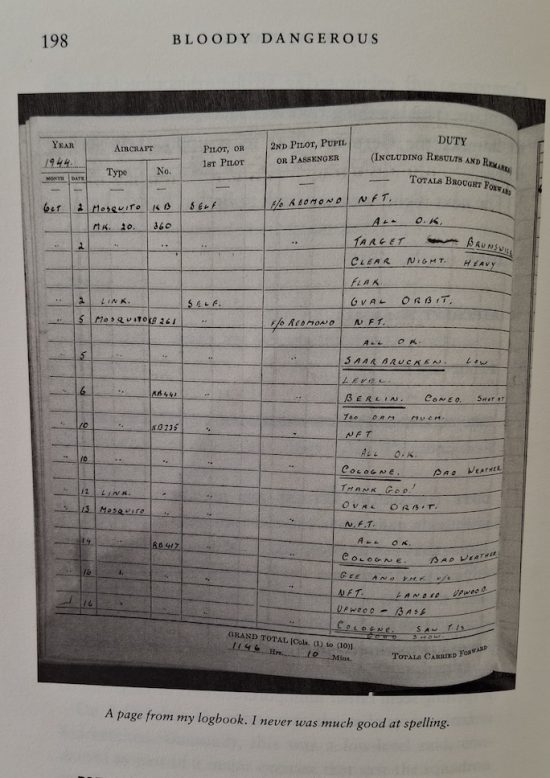
Getting coned by searchlights and shot at a lot makes the question of spelling accuracy seem rather unimportant.
After his fiftieth and final operation flight, he finished the war and his active flying service, first on the transatlantic ferry route and then as a European diplomatic mail “postman” when he won a commendation (see photo below). After that he continued for a spell in the RAF Reserve.
You will not buy this book for the quality and quantity of the illustrations. Apart from those relating directly to the author, the remainder are stock images of aircraft and places associated with him. You will buy this book because it is an engrossing and highly entertaining story of a very brave man. Other than new material appearing in posthumous diaries, it is unlikely we will get fresh narratives such as this appearing from those who fought in WW2. We are privileged to reflect on and enjoy their stories.
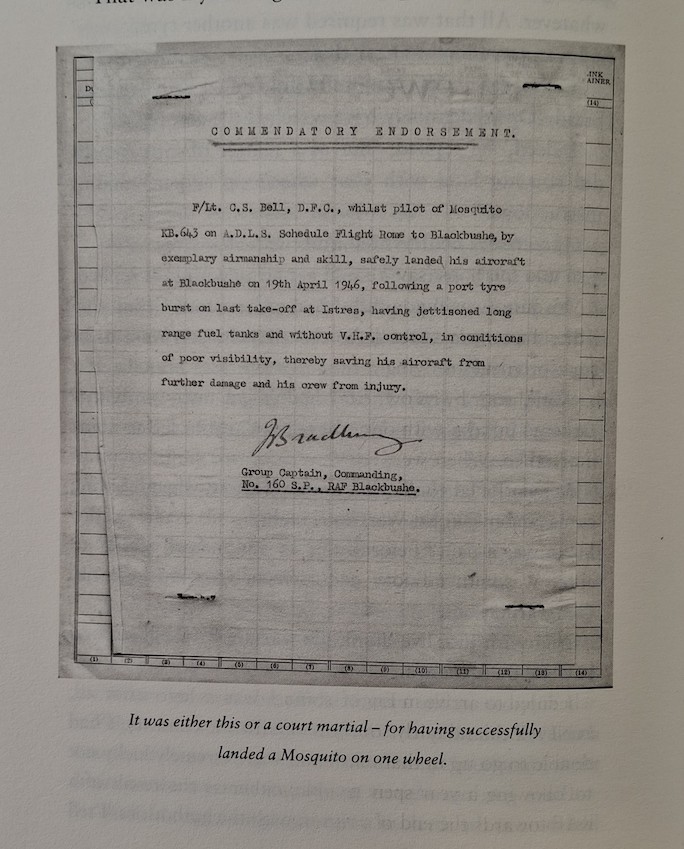
The court martial would have resulted if an illegal passenger had been injured or worse.
Why did Bell wait until now to write about his wartime experiences? Well, he didn’t retire as a chartered surveyor until he was ninety-eight! It was only after his wife of seventy-three years died and he felt that “it is important at this moment in our history that we remind ourselves what we were fighting for during the Second World War” that he put pen to paper. And typical of the man, an abseiling (rappelling to Americans) event he undertook for charity resulted in an entry in the Guinness Book of Records; he was 102 at the time.
The author has the last word. He was invited to a conference to meet an ex-Luftwaffe pilot. Although not keen—he makes his abhorrence of the Nazi regime very clear—he agreed. Even less keenly he also agreed to meet a German former paratrooper: “So I went over and found this utterly miserable-looking old codger sitting by himself. ‘Guten Tag,’ I began, summoning up my best German. ‘I suppose you must be the former paratrooper.’ He looked at me blankly. ‘No.’ He said. ‘I’m Ted, the taxi driver.’’”
Copyright 2026, Paul Lea (speedreaders.info)























 Phone / Mail / Email
 RSS Feed
 Facebook
 Twitter