
Baden-Baden: The Hidden Motor City
Fascinating Automotive History with Benz, Caracciola & Co.
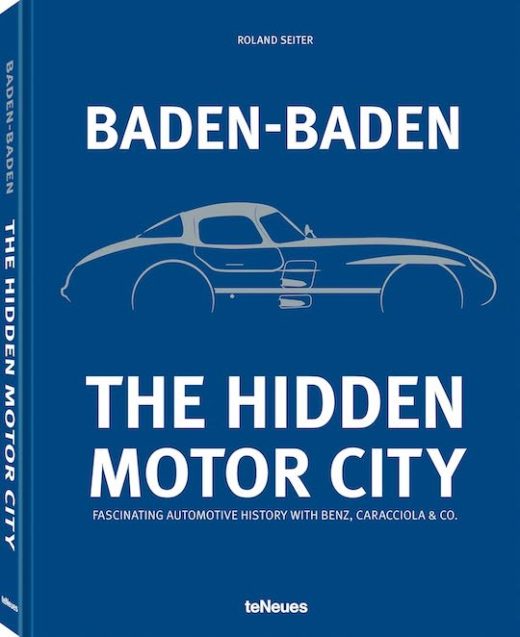 by Roland Seiter
“To call Baden-Baden a ‘Hidden Motor City’ in the style of Detroit is bold. Cars were not made here on a large scale, nor was the town a leading centre of the automotive industry. And yet, with this book, we would like to present evidence that this UNESCO World Heritage Site is one of the world’s pioneering cities in all things automotive.”
With these words, the book opens. Yes, it is bold to imply a common denominator to these two cities—and it is bold to stitch together a quite upscale book to make that case.
The book exists only in English so its target audience must be presumed to be non-German, ergo the mention of Detroit must have been intended as a relatable point of reference for the sort of reader who has probably never heard of this spa town in southwestern Germany on the fringes of the Black Forest near the border with France. It is the hot springs that gave Baden-Baden the name that made, and make, it famous and it is the hot springs—and later, the Versailles-inspired casino—that in turn attracted an “illustrious and financially strong audience [to] Europe’s summer capital of the time.” And it is those well-heeled folks, the “influencers” of the day, including royalty and nobility that prompted automakers like Daimler and Benz, as well as aviators like Zeppelin to establish a presence in “the Grand Ducal Town of Baden-Baden”, strictly speaking a Margraviate.
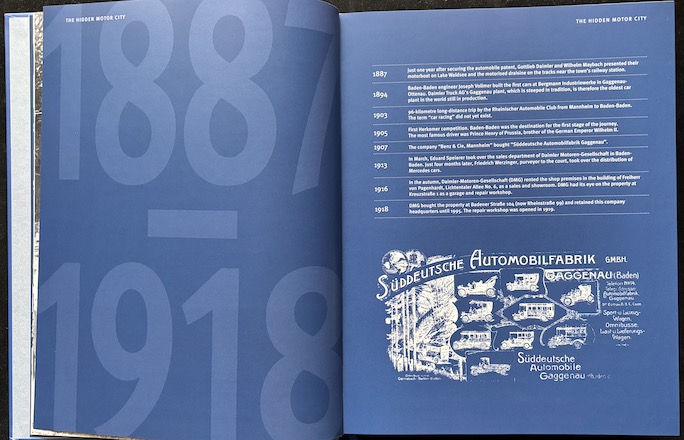
The book is divided into three principal eras.
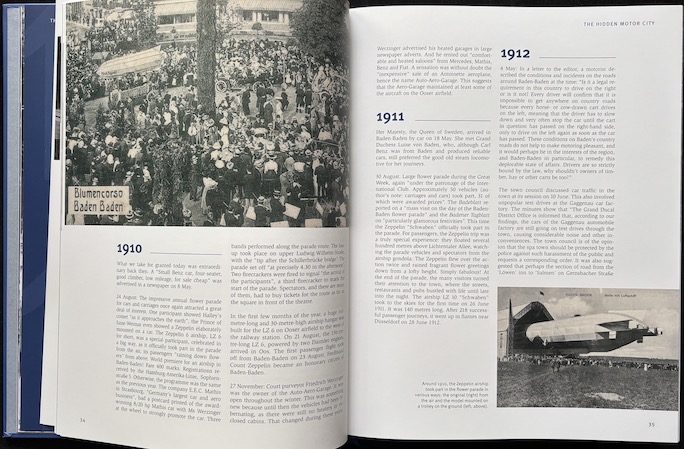
During a 1910 concours called a “flower parade” an actual Zeppelin airship (LZ 6) overflew the city dropping flowers while a small Zeppelin model mounted on a trolley (top left) took part in the parade.
This spread may serve as an example re useful/helpful detail lacking: passengers could fly on the LZ 6 that day and drop flowers; tickets were 400 marks—how long was the flight? of greater interest: is 400 marks a lot? A few sentences earlier an ad for “a small Benz car, for sale cheap” is referenced. So how cheap is cheap? A few pages later Daimler’s annual rent for its local sales outlet is given as 12,000 Goldmarks in 1916; if a large commercial shop rents for 1000 marks a month, then 400 marks for an across-town Zeppelin flight is not cheap. Also, why make a foreign reader wonder if a mark is the same as a goldmark?? Especially since the gold standard had been abolished by 1916 for two years already. A few strategically placed words would take the book to a higher level! (If you’re curious, read up on the fall of the German Empire, the revolution that led to the Weimar Republic, and the resulting hyper-inflation that gave its bedraggled mark the nickname paper mark.)
There is a lot to discover in this book but you either have to be insatiably curious or already know what to expect to even pick it up in the first place. For instance, that excerpt at the top, followed by two more brief paragraphs, constitute the whole of the introduction so the reader is not given much to apprehend how the book works or what guided the author’s thinking.
The book can be thought of as a yearbook, 1887 to 2024, presenting stand-alone entries, often in the form of newspaper excerpts, in chronological order, often with commentary. Stick with it and read enough of them—and/or take in the smartly designed Table of Contents—and you will indeed come to appreciate that Baden-Baden does have a place in automotive history and also on the automotive calendar still today as a hub or waypoint for motoring events from concours to rallies. In other words, the subtitle is not hyperbole, but that Gullwing on the cover is quite the red herring because there is no relevant connection other than the 300 SL (and 190) club having had several annual gatherings here.
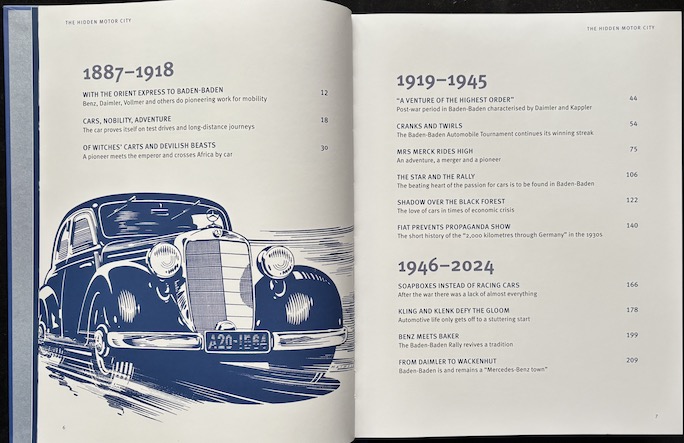
That said, Daimler has had a connection to the area since 1916, having established a sales and repair facility in the area that continues to this day albeit nowadays in private ownership. Which brings us to the writer of the Foreword, Ernst-Jürgen Wackenhut. The book says nothing about him but most Germans would recognize him as the third-generation head of a conglomerate of businesses (including publishing), specifically, one of the leading Mercedes-Benz agents in southern Germany.
It’s not until the Impressum on the last page that you’d learn that the book was created “in cooperation with Wackenhut GmbH.” What form that took exactly is not specified. Wackenhut is not wrong when he remarks that the town is “a treasure that is probably unknown to many, or no longer remembered in this regard” so whatever support his company threw behind the book is a good thing even if does in places read like a Chamber of Commerce publication . . . which is the time to say that Seiter (b. 1956) was Head of Media and Communications for the city of Baden-Baden from 1990 to 2022. In that capacity he would have been immersed in any and all aspects of the goings-on in his town which would have sharpened his eye for relevant archival material such as the newspaper clippings he so extensively draws upon to flesh out societal/political as well as transportation-specific points. Not least, he’s been interested in classic cars since youth.
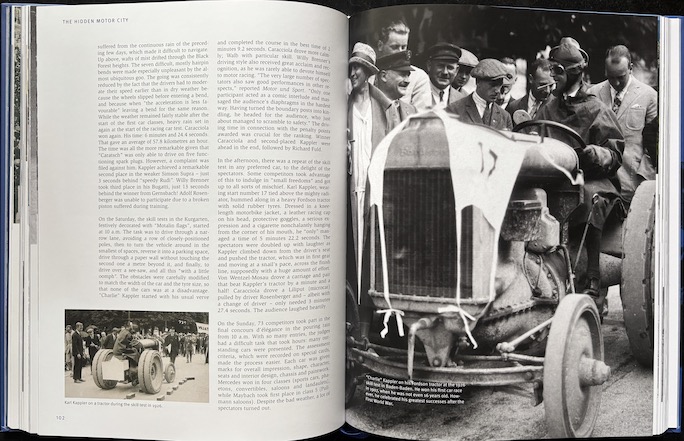
Not glam but eminently practical: a tractor gymkhana in 1926. This is a Fordson.
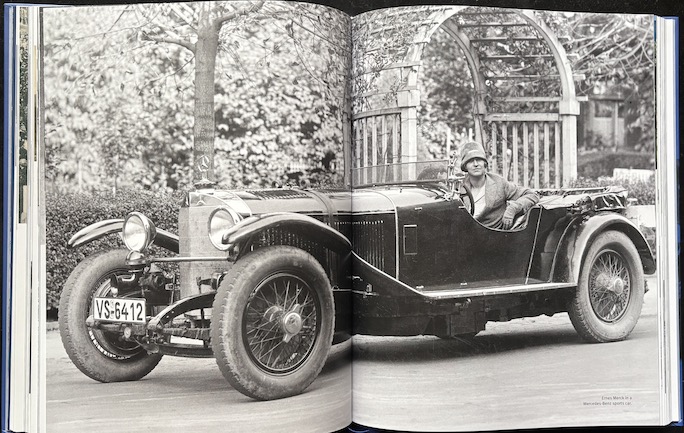
The book is a generous 9.5 x 12″. Captions are usually short, this one only says “Ernes Merck in a Mercedes sports car” so hopefully you still remember that a few pages earlier she was referred to as “Europe’s most beautiful racing driver.”
The book is very well illustrated and has high production values, just as one would expect of a teNeues publication.
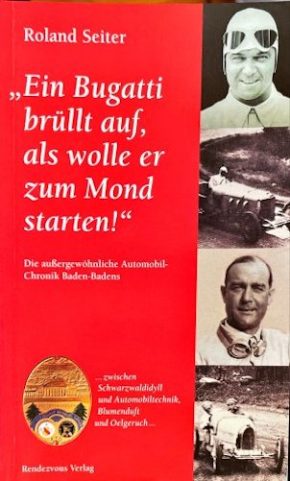 Lastly, while the Foreword mentions Seiter’s 2002 book Ein Bugatti brüllt auf, als wolle er zum Mond starten! the reference is incomplete and would have you assume the book is about a Bugatti. The subtitle—Die aussergewöhnliche Automobilchronik Baden-Badens (ISBN 978 3980 547758)—is the crucial clue that both books circle around the same core topic. In English the title would be A Bugatti Roars as if it Wanted to Take Off for the Moon! The Exceptional Automobile History of Baden-Baden. Still easily found used but the publisher is defunct.
Copyright 2025, Sabu Advani (Speedreaders.info















 Phone / Mail / Email
 RSS Feed
 Facebook
 Twitter