
Formula One, The Champions: 75 Years of Legendary F1 Drivers
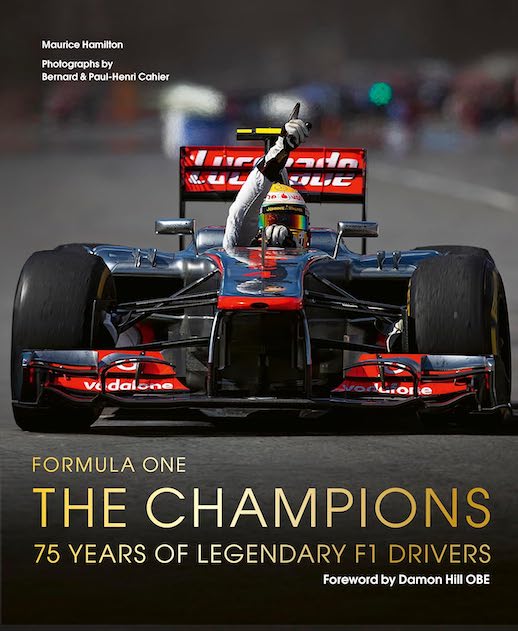 by Maurice Hamilton
“The fact that such relentless resolve and thrilling talent had to be maintained across an entire season has helped elevate each driver into a pantheon of sporting achievement that sets them apart from the rest.
That is not to say that other drivers were less deserving, merely that this select group worked the demanding and diverse circumstances to best advantage.”
Ok, we will refrain from beginning yet another review of an F1 anniversary book by tilting at this particular windmill: 2025 is 75 years of something, just not F1 in its current form. Before your eyes go crosswise, May 1950 Silverstone really does count as the inaugural event of the World Championship in that type of racing, it just wasn’t called what we now know it as. (Get the full picture here.)
Given that these days F1 is a BIG deal, literally and figuratively, it is no wonder that a pile of new books ride the coattails of the anniversary. We have reviewed a select few and ignored others.
We won’t ignore this one because right off the bat there are three factors that deserve notice: a different approach to the topic, an author with an excellent reputation in this genre, and a very approachable price to entice readers who are just beginning to explore F1. That price is even more remarkable (even for a powerhouse publisher known for good books at good prices) when you take into the account the book’s physical properties—binding, size (9.76 in x 12.01 in), paper, photo reproduction.
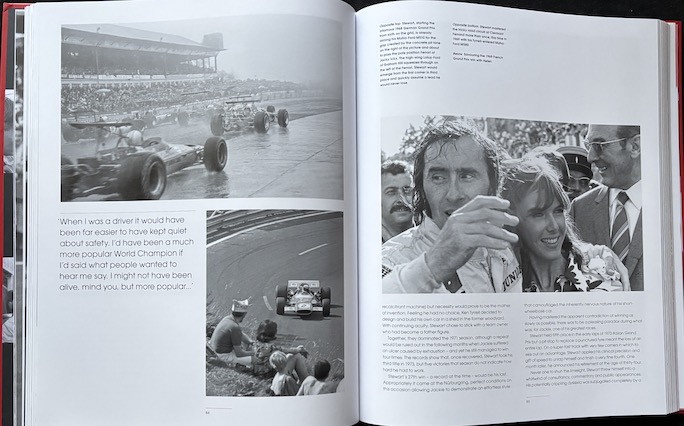
This is a relatively short book, meaning everything in it has to earn its place. This pull quote (l) very much does. It perfectly represents the essence of the man who spoke those words: “When I was a driver it would have been far easier to have kept quiet about safety. I’d have been a much more popular World Champion if I’d said what people wanted to hear me say. I might not have been alive, mind you, but more popular . . .” Who he? Jackie, now Sir Jackie Stewart, 3-time World Champion and 100-time good guy.
For the sake of the new-to-F1 reader it is worth pointing out that the photos are by Bernard Cahier and his son Paul-Henri, names you will encounter in a plethora of motorsports books, which means the more you read such books the more often you will encounter their “best” photos. Which is another way of saying that some folks may have already seen some of the shots in this book. Even if, they are worth looking at, especially when so well reproduced and properly cropped. Some folks may in fact have seen this book before; that would have been the previous version that came out in 2020 on the occasion of the 70th anniversary. This new edition is presented as “fully revised and updated” but it is not clear if these words are used interchangeably. (Hamilton’s intro remained the same but the—very, very good—Foreword is now by F1 champion Damon Hill.) The obvious update takes the form of an additional four seasons of coverage; conveniently, they required only one entry: Max Verstappen.
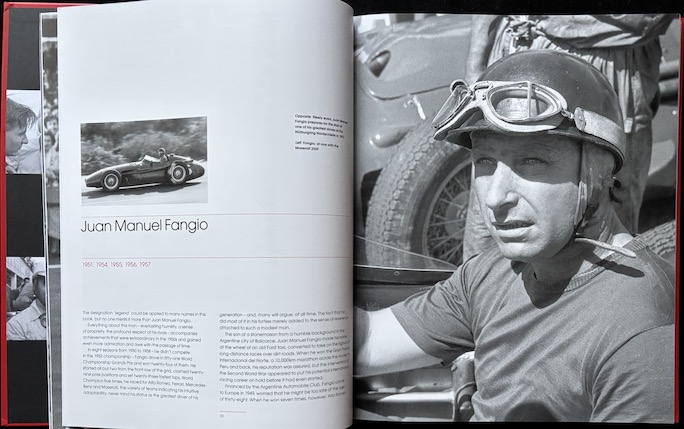
He was the second world champion, and every discussion about GOATs will involve him.
The two sentences in that opening quote we picked, from Hamilton’s Introduction, speak to matters that on the one hand are obvious and on the other hand deep. Do take a moment to think about other sports, be it a series or one-offs like the Olympics. In the former the athlete does not compete against the same rivals throughout the course of the season, and in the latter the delivery of the chart-topping achievement happens in a very short period of time. Not so motorsports.
 And that second sentence in the excerpt will immediately elicit a reaction from longtime observers of motorsports: racing is not a clean sport, meaning some of the very names in this book, in the very pursuit of the ultimate prize did indeed work “the demanding and diverse circumstances to best advantage,” by hook and by crook if necessary. Lewis Hamilton getting run off the road on the last lap of the last race of the season and losing his otherwise sure championship; the winningest world champion Schumacher feigning loss of car control at Rascasse to bring out the yellow flag that would prevent Alonso from achieving pole position—examples abound. This is not what this book is about! Because Maurice Hamilton is a seasoned enough journalist not to lose the plot of the particular book he is writing here.
The book jacket says all too little about him but knowing more could only raise him in the reader’s esteem. For instance, he initially wanted to become an F1 team manager but didn’t know anyone so made ends meet by working in pubs and selling cars, houses, office equipment, plastic pipes. He created fake credentials for a fake motorsports magazine just to get into the paddock. What all this means is that he made sacrifices to achieve his goal; ergo he relates to the men he writes about.
Books about athletes are often accused of bias or favoritism but in this case the 34 names are a matter of historic record and undisputable. The one area in which Hamilton could have put his hand on the scales is the trap that so many in the commentariat fall into: who be the GOAT? Hamilton knows better, and being a polite fellow, takes the air out of that futile question by referring to it as “energetic and informed discussion, usually predicated on a personal preference swayed by affection.” That last word is key: he gives you here the mere facts, without spin, in many/most cases not even mentioning and certainly not dwelling on the infractions (or ascribing motive) such as mentioned above and leaves it to the reader to discover “their” favorite/s.
To each driver are given about six pages, each starting with a full-page photo. Both body copy and photo captions are well focused, with minimal duplication among them. The drivers are presented in chronological order of first win; this is not spelled out but needs to be understood lest there be confusion why, say, Häkkinen 1998 is immediately followed by Alonso 2005. How will you find out who won in the intervening years?? This is quite unsatisfactory and we can think of at least three easy fixes.
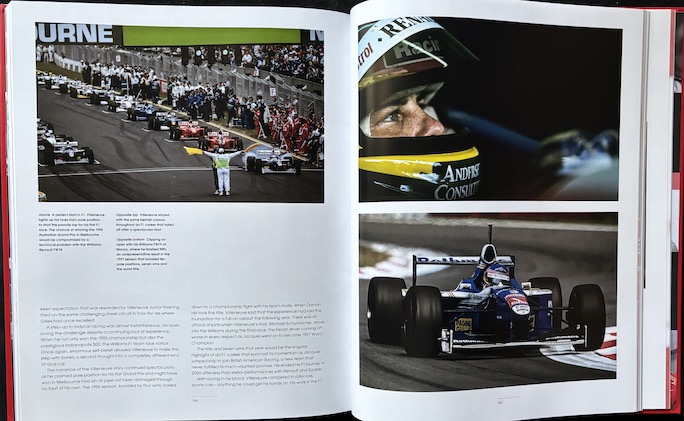
We picked this spread just to illustrate that this is not a general motorsports history, meaning you’re on your own to suss out items that are outside the scope of driver profiles: top left, look at the starter (actually, two guys) standing in front of a field of cars about to let loose. It’s 1996, and no one today would allow such an unsafe activity!
Attentive reading as well as attentive photo study will lead to the discovery of any number of useful insights that are not addressed in the text because they would not be of primary relevance to the synopsis of a driver’s career arc.
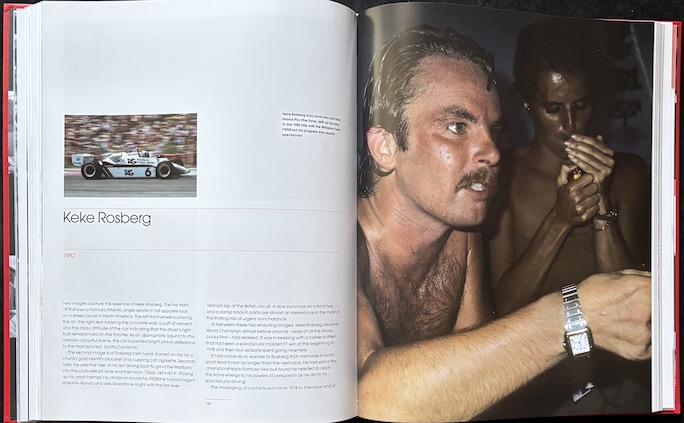
The only reason to have picked this photo is to make the point that both Cahiers had a way of getting up close and personal but never in the face. Blazing eyes, pointing finger, dripping sweat—something is going down here! Not the most flattering shot but at least Rosberg is wearing his Cartier!
A quick word about the Cahiers. Each man is known for a distinctive style or approach to photography but the photos used here are not attributed which will make for an interesting guessing game even among cognoscenti. The book jacket doesn’t tell you much about them either—and nor will we—but it’s about time to wonder why just about every book and every publisher of their work simply regurgitates “official” language lifted straight from the Archive’s website.
And just so we’re not losing the plot: a LOT of book for LITTLE money, useful in every regard, you can read it in one fell swoop or consult again and again as needed, it’ll settle innumerable arguments, meaningful photos by intelligent people of intelligent people. Winner winner chicken dinner.
Copyright 2025, Sabu Advani (speedreaders.info).







 Phone / Mail / Email
 RSS Feed
 Facebook
 Twitter