
Maserati 250F: A Legendary Formula 1 Car
 by Walter Bäumer & Jean-François Blachette
“When in the factory, some engines needed to be overhauled or had been damaged. To get the particular car back in time for the next event, sometimes the engine was taken out of one car and installed into another 250F that needed to be transported to the next race on short notice. The engines then received a ‘new’ number to match the chassis number of the car. All this was done to make the customs happy. Back in the factory, the engines were then swapped back.”
That last sentence is what has plagued researchers for . . . decades, so if you are wondering if the world needs another book on the 250F: yes, this one.
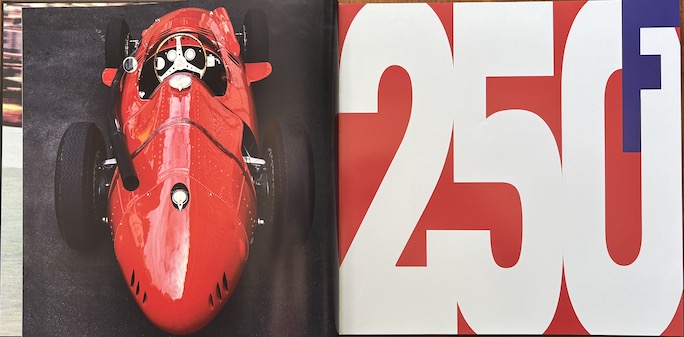
How’s this for eye-catching design? The book is big—11.6 x 11.4″—so calibrate your pupils.
If you are new to the world of this important Maserati model, consider yourself lucky to be given here a solid start. If you are an old hand, you will be frowning instead because so much 250F material had not moved the needle. Stand down. Right on the Dedication page of each volume, the authors invoke the names of the patron saints of serious Maserati research, David McKinney (d. 2014) and Barrie Hobkirk (d. 2019). And this is not just lip service—their work is a direct and specific influence. The two men had combined their years/decades-long efforts in 2003 to publish Maserati 250F (Crowood), the book that became and remained the yardstick even if some questions regarding authentication remained due to the limitations of data-crunching technology at the time but also the then still rudimentary importance owners and researchers assigned to the preservation and reconciling of data. Bäumer and Blachette draw on McKinney/Hobkirk’s work, so much so that they acknowledge that their own work could not be in the state it is in now without it.
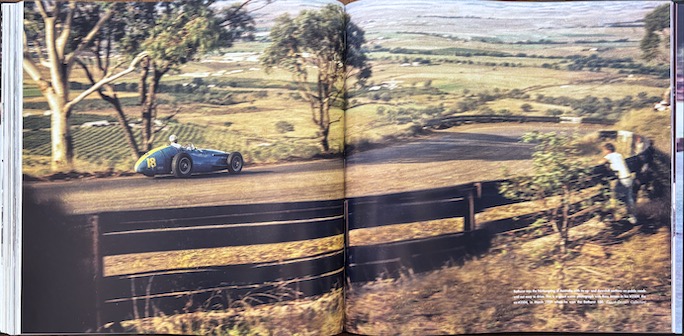
Different times. Can you deduce from the landscape where this is? “Bathurst was the Nürburgring of Australia.”
To those within the Trident world, Bäumer and Blachette need scant introduction. Of Bäumer’s five Maserati books for this publisher this is the third written with author and historian Jean-François Blachette, a former car industry executive and still the president of Club Maserati France and editor of the club magazine. He presides over a large photo collection of the marque from which this book benefits—if you think you’ve seen everything worth seeing you’ll be pleasantly surprised by the previously unpublished material here.
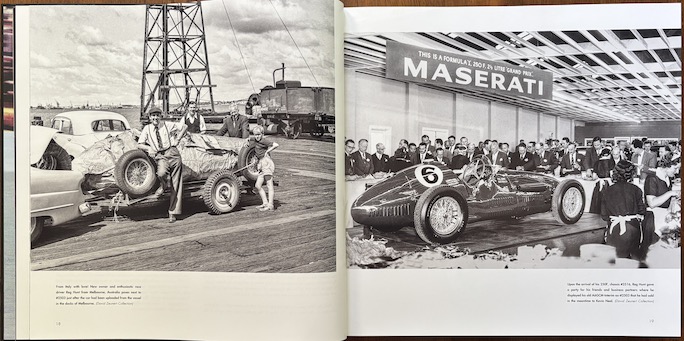
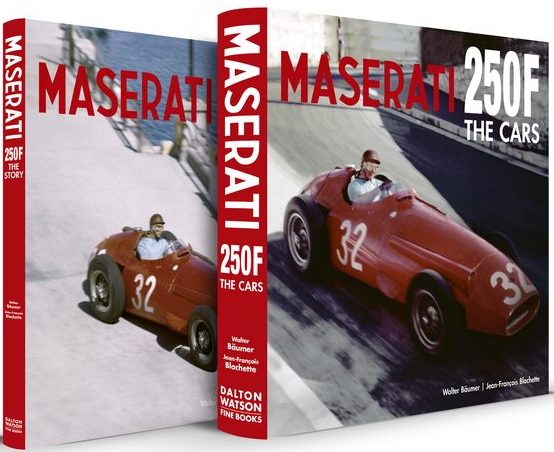
Great caption: (l) “From Italy with love!” Can’t wait to tear the wrappings off of that present.
Looking at the book covers above, that the book on the left looks so much thinner than the one on the right is less a function of perspective but page count. The former contains about 70% fewer pages—but even at “only” 224 pages it outpaces just about any other book about the 250F. Then add the 660-odd pages of chassis histories in Vol. 2 and you have here the most thorough treatment yet.
Each volume is individually paginated and has its own multi-layered, thorough Index. Vol. 1, “The Story,” dedicated to McKinney, presents the overall model history, beginning with the 250F’s predecessor and the relevant technical and design considerations in light of the racing regulations and formats. Stand-alone chapters give mechanics their due, as well as the competition, without which a race car is an exercise in futility. Profiles of drivers and other people associated with Maserati’s racing efforts round out the picture.
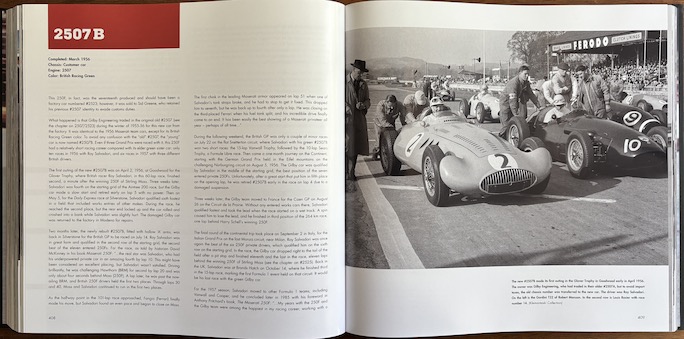
A perfect example of the identifiation conundrum. “This 250F, in fact, was the seventeenth produced and should have been a factory car numbered #2523; however, it was sold to Sid Greene, who retained his previous #2507 identity to evade customs duties.”
Vol. 2, “The Cars,” is dedicated to Hobkirk because the spreadsheets he had created for each racing season and amended if/when new verifiable info came to light are the backbone of the chassis histories. In view of the intro quote above, the fact that he recorded engine numbers and correlated them to the events in which they were used is the key reason many irregularities in the record can now be unraveled. It is a pity that he is no longer alive to see it and receive the thanks he so dearly deserves. The flip side to uncontestable data is that some people (well, owners, “the trade”) will now be scrambling to hide their sins of having fudged provenances when there was little chance of being proven wrong. The well-chosen photos will play a role in that regard as well. The chassis/engine combos continue to be problematic/divisive even today, in Historic Racing, but that is a matter outside the scope and purpose of this fine book.
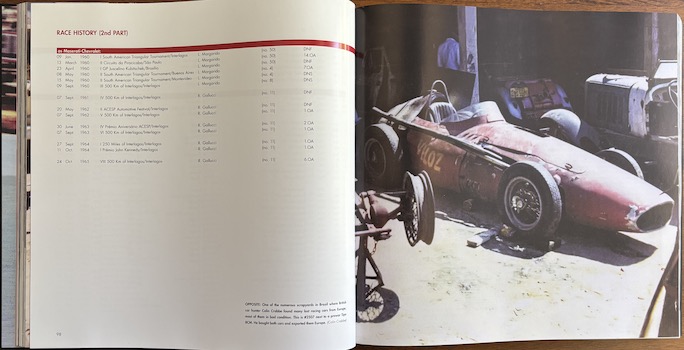
(l) An example of a table of race results in the chassis histories in Vol. 2. (r) An example of what happens to race cars past their prime.
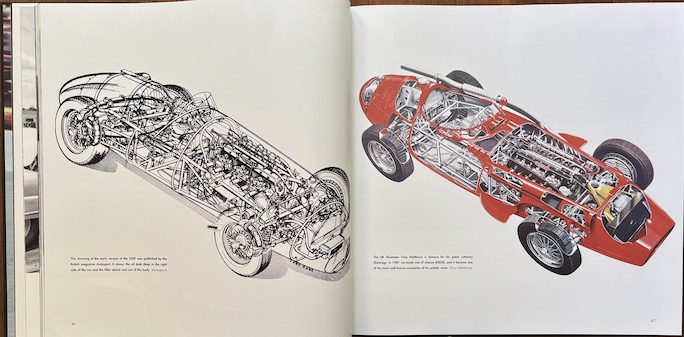
This is a Dalton Watson book, meaning paper, printing, photo reproduction are state of the art. Many photos are full-page which is great for spotting detail and conveying atmosphere but—no complaints!—is only achievable by giving up that synchronicity between body copy and images. The photos are, however, very well captioned so you always know what you’re looking at, and then you let your fingers do the walking to find further enlightenment in the text or consult the Index.
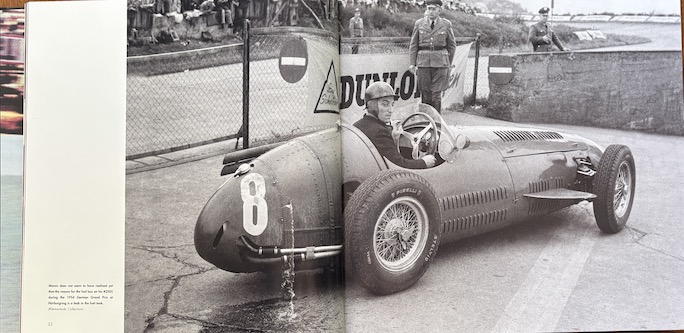
Big photos reveal small details: there’s a hole in the tank!
One can only wish that the people who need to see this book have the means to do so. Even libraries will struggle to find $400 lying around. Donors/sponsors, time for some civic duty, eh? Just think of the tax write-off!
Copyright 2026, Don Capps (speedreaders.info).












































 Phone / Mail / Email
 RSS Feed
 Facebook
 Twitter