
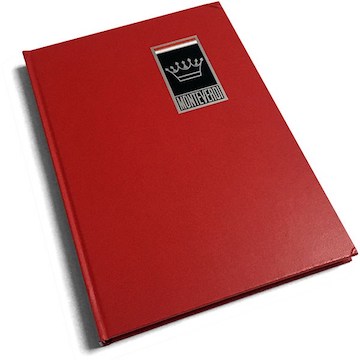
27: Patrick Tambay – The Ferrari Years
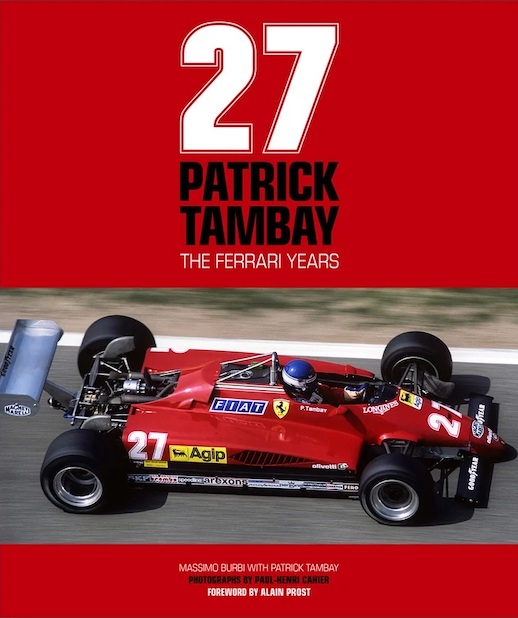 by Massimo Burbi with Patrick Tambay
“The day Patrick Tambay won the 1983 San Marino Grand Prix I was seven years old and I knew nothing about Formula 1. I tried to impress the people in the room by saying that Niki Lauda was no longer driving for Ferrari, but that observation was met with little interest by the audience as the news was almost as old as I was.
It was not my decision to watch the race that day. I was just a kid in a room full of grown-up men after a typical Italian Sunday lunch, and the remote control was way beyond my reach. But I was the only one to stay until the end.
For reasons I have never fully understood, my imagination was instantly fired by that blue and white helmet inside the car carrying number 27.”
Since the inaugural F1 Drivers World Championship in 1950, only two seasons have been won by a driver with a single victory during the year. One was 1958 when Mike Hawthorn triumphed in a Ferrari. The other was 1982 when …
At the beginning of 1982, Gilles Villeneuve (a close friend of Tambay) was firmly established at Ferrari and was a favorite of both Enzo himself and the Tifosi. On the other hand Patrick Daniel Tambay (1949–2022) seemed to be at the end of a lackluster F1 career. He had made his name with the Carl Haas Can-Am team then effectively lost it with two disastrous years in F1 at McLaren when they were at their lowest ebb. He rebuilt his reputation with Haas again only to strike unlucky in F1 with Talbot Gitanes and Theodore. Following the drivers strike over license condition changes at the 1982 South African GP and disillusioned with the politics, he vowed to turn his back on F1.
Villeneuve’s fatal accident at Zolder in May 1982 changed everything. Had timings been slightly different it might have been Tambay who went to Ferrari in 1978 and Villeneuve to McLaren. But Ferrari also remembered that Tambay had personally contacted him regarding the circumstances as to why he had declined a drive in 1978 (he had only just agreed with McLaren and didn’t want to go back on his word). Tambay was now available and at last he was signing for the Prancing Horse
This book describes in detail Tambay’s 18 months at Ferrari. From the outset he understood that he had been recruited to assist in helping Didier Pironi and Ferrari to respective World Championships. It was a steep learning curve, and he knew he didn’t have the sheer talent and speed of Villeneuve. Also he was carrying Villeneuve’s “iconic” race number 27. But he knuckled down and started to impress people both inside and outside of the team by just how quick he was.
By the time of the German Grand Prix, the Drivers Championship was Pironi’s to lose. After being dominant during practice, he suffered career-ending injuries in a totally unnecessary wet track accident. In the space of a few months Ferrari had lost both of their first-choice drivers. Unbelievably, Ferrari morale was infinitely boosted when the following day Tambay won his first Grand Prix.
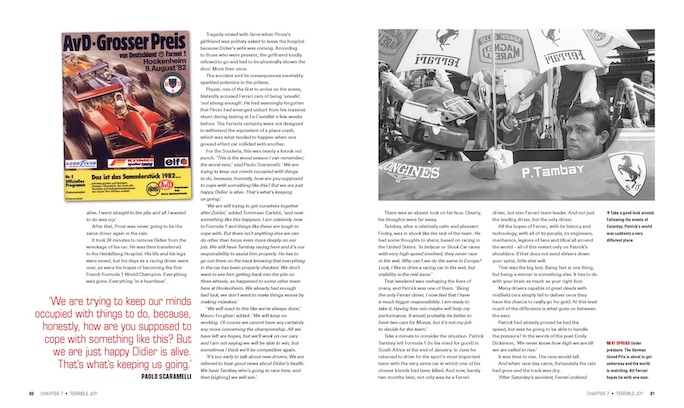
Tragedy and Triumph, Germany 1982.
A highly disjointed season continued. Apart from the drivers’ strike, cars were disqualified for illegal water replacement (an unsuccessful weight reduction dodge) as well as illegal wings. In Canada Riccardo Paletti had died when his car hit Pironi’s stalled Ferrari. In France Rene Arnoux beat Alain Prost despite explicit Renault team orders not to—shades of the Villeneuve / Pironi situation at Imola earlier. And then a therapist-inflicted (!) neck injury meant Tambay (and therefore Ferrari) could not compete at the Swiss / Dijon Grand Prix. It took until this race for Pironi’s points total to be overtaken. Effectively all that could be hoped for now was the Constructors Championship. A re-occurence of the neck problem meant a non-start at the final Grand Prix at Caesars Palace but enough had been done to clinch the Constructors Championship. And the top driver? Keke Rosberg with a single victory, and the last Championship for the Ford Cosworth DFV.
Those 1982 race results are unlikely to be ever repeated. Eleven different drivers from seven different teams won. And there was a run of nine different races won by nine different drivers. Motorsport journalist Nigel Roebuck wrote that 1982 was “an ugly year, pock-marked by tragedy, by dissension, by greed, and yet, paradoxically, it produced some of the most memorable racing ever seen.”
Tambay had a contract for 1983 but trouble was brewing. He was joined by the more ambitious and politically skilled Rene Arnoux. It also didn’t help that ground-effects designs had been banned and if you had the wrong tire supplier things were even more difficult. But a second emotionally charged victory came at Imola—where the Villeneuve / Pironi fallout over team orders had occurred 12 months earlier.
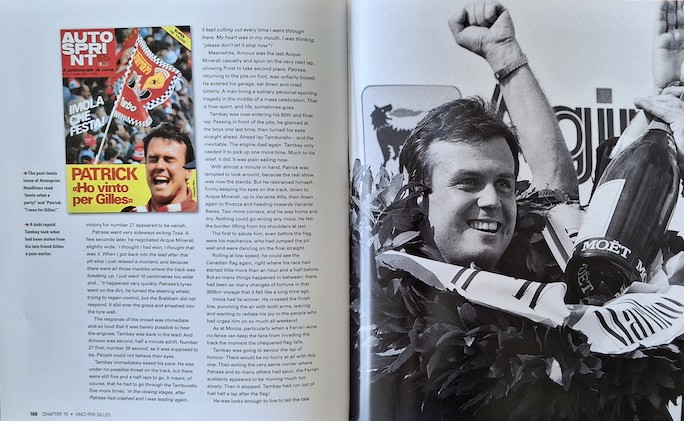
As good as it gets. Imola 1983.
This was as good as it got. A major disagreement with Ferrari Sporting Director Marco Piccinini over a trivial matter was to have fundamental repercussions.
Arnoux was now winning races, Tambay not finishing. At the end of September a journalist phoned Tambay asking if he had heard the news. He had not and the news was he being replaced by Michele Alboreto (an Italian, surprise surprise) for 1984. Ferrari did win the 1983 Constructors World Championship despite neither driver finishing in the top two of the Drivers Championship.
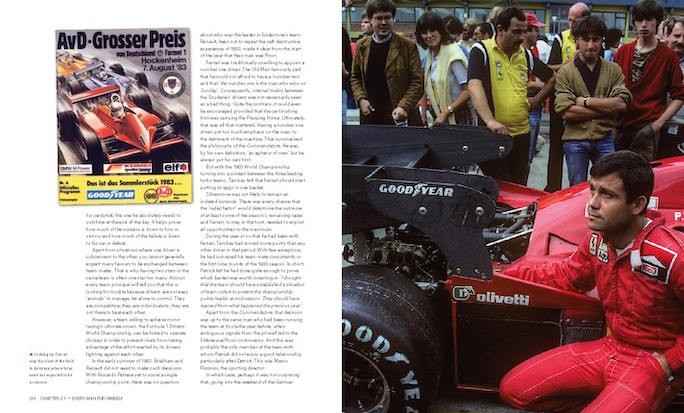
1983 and the seasons start to go downhill.
For 1984 Tambay replaced a sacked Alain Prost at Renault but his post-Ferrari F1 days were as unsuccessful as those prior. None of this is mentioned in the book, its focus being on the Ferrari years.
Professional F1 has never had a surfeit of shrinking violets. The 1980s saw an increase in the number of drivers who would literally stop at nothing to win. A theme that occurs throughout the book is Tambay being described as a gentleman who acted with integrity. But throughout his time at Ferrari Tambay was damned with the comment he was “a gifted test driver.”
At the end of his Ferrari stint he was a multiple Grand Prix winner, something not accomplished by a good number of Ferrari drivers. And for the record, Alboreto won three races for Ferrari over five years, with Arnoux winning three over three years—all in 1983. So in retrospect Tambay’s record of two wins in eighteen months is not unimpressive.
Patrick Tambay passed away in 2022 at the age of 73.
This book was written in collaboration with Tambay. Unsurprisingly it is somewhat subjective, with the author unfailingly taking the side of Tambay at all times. He also “creatively” embellishes and builds the tension surrounding events to delve inside of the participants’ thinking. Despite this it is a useful narration of two epic and controversial seasons in F1 history. If you are Tambay / Ferrari admirer you will want to take a look.
There is no index and a sparse bibliography.
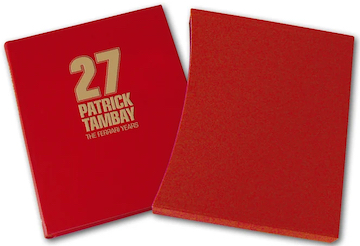 The majority of the high-quality photographs in this book were sourced from the Cahier Archive. The author Massimo Burbi runs his own engineering design studio in Tuscany, Italy. This is his first (and apparently to date only) book.
Also available autographed by Tambay ($103) and in a leather-bound limited edition (309).
Copyright 2026, Paul Lea (speedreaders.info)





 Phone / Mail / Email
 RSS Feed
 Facebook
 Twitter