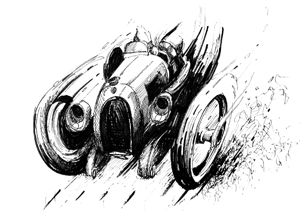

Brooklands Belles: The Women Racers Who Took on The Men
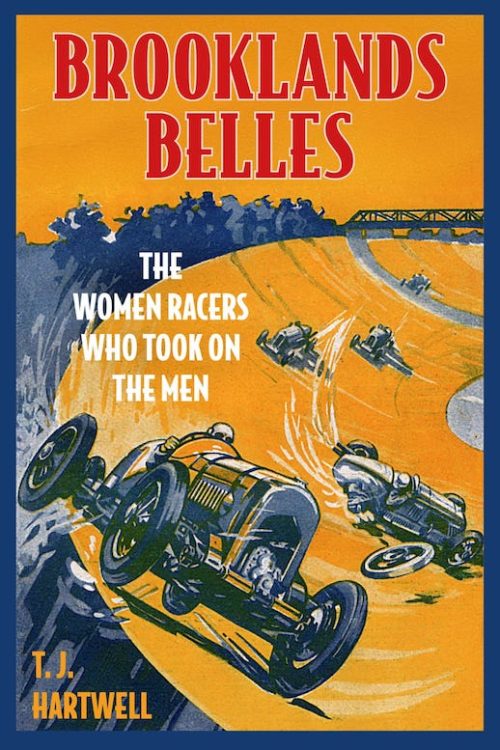 by T.J. Hartwell
“It was a small band of impressive women who graced the Brooklands track and they deserve greater acclaim for their achievements. They challenged the norms of the day and for a few short years satisfyingly unsettled a male sporting hegemony with their motor racing feats. They were brave, talented and brought a style and glamour to motor racing at the Weybridge circuit that masked their steely determination to compete and win.”
Brooklands opened in July 1907 as the world’s first purpose-built motor racing circuit. It is primarily remembered for its massive concrete banked turns up to 30 ft high.
The circuit could not have been built without the skills and determination of the first Brooklands Belle described in the book, even though she was not a racer. Ethel Locke King (1864–1956) was married to Hugh, who owned a rural estate in Surrey, a county south of London. At the other end of the twentieth century they would have been described as rich petrolheads. The couple had driven their 50/70hp Itala to see the Coppa Florio race in Italy in 1905. Although delays meant they were too late to see the race, conversations with Italian drivers afterwards made them determined to build their own super-speedway in order to encourage UK car manufacturers to compete in international motorsport.
The circuit was to be built within the estate and initially progressed rapidly. However Hugh’s increasing, stress-generated ill health and an escalating budget threatened to derail the entire project. Ethel stepped in, managed the financial and contractual problems and deservedly led the track opening ceremony, driving her 40hp Italia “Bambo.”
The book’s main topic is the story of the Belles who raced there, although we learn about some pioneers who raced elsewhere. Some Belles merit entire chapters to themselves, others with shorter narratives are loosely grouped within themes. Other chapters include Motorcycle Belles, the Brooklands Scene, as well as an After Brooklands finale.
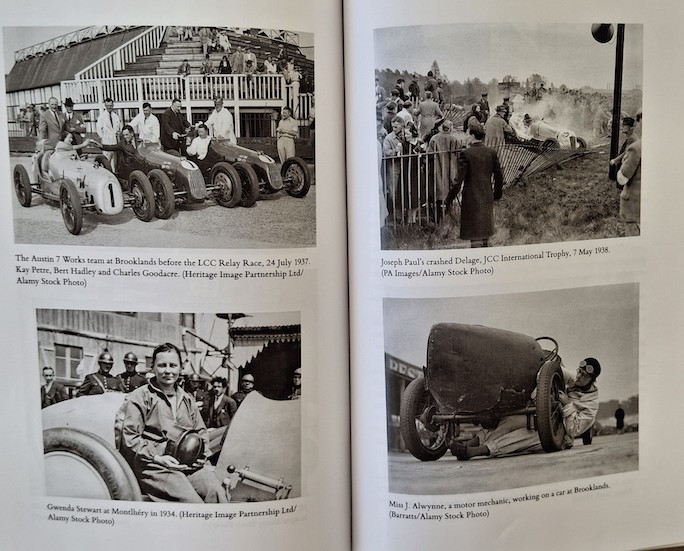
The book does not just detail car and race details but also the political and social changes taking place in the 1920s and 1930s, and it is populated by copious archive material, including numerous contemporary newspapers and periodicals. It includes quotes from the doyen of Brooklands history Bill Boddy.
It took a while for women drivers to not be dismissed as “a Menace to the Peace of the Nation.” The press then (as now?) found plenty of headline coverage for the Belles. Fay Taylour, skilled on two wheels and four, was prepared to go to prison rather than pay a speeding fine. She was “emulating the suffragettes” and would “take her beach pyjamas” to jail. We also get “Penny (the British coin) to decide Women’s Speed Duel with Death.’”
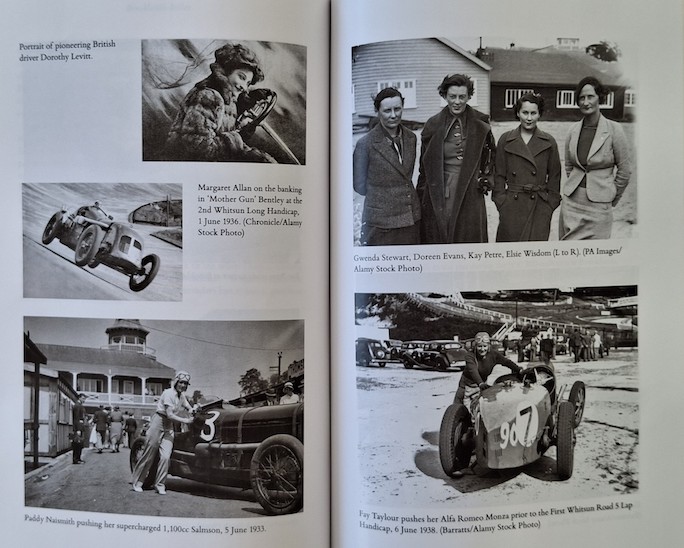
Brooklands Belles including Fay Taylour and Kay Petre.
The book spans a wide range of characters and talents. Consider Romantic novelist Barbara Cartland who organized a ladies race at Brooklands. But the outcome was some furious lady drivers who complained of being mislead and the event was panned in the press. It was never mentioned in Cartland’s memoir. At the other end of the scale was Kay Petre, one of the most accomplished women drivers of the era, possibly all time. She hustled a 10.5L V12 Delage around the circuit at an average speed of 134 mph. It was a tragedy that a crash that was not her fault (the other, male driver was banned from competition for two years) terminated her career prematurely.
By its very subject matter and the number of Belles described, the story is not suitable for a straight chronological sequence from 1907 to 1939 when the circuit closed—not to be reopened. This structure leads to the major problem of not being able to find anything/anybody with ease, exacerbated by the lack of an index, although there are notes and bibliography sections.
If your interest is piqued at the very start, as mine was, by the frontispiece photo “George Eyston’s Dancing Daughters: 1935 MG Le Mans,” you will either have to plow through the entire book or enlist Google to discover more. This applies to all the photos within the book—they don’t have page/chapter references. Added to this, the narrative jumps within chapters. For instance, just as we are about to experience the official opening, we are diverted into an explanation as to how the track developed over the years, before we revert to the opening. There is a “Map of the original circuit” but none for the ensuing configurations so we are at a loss where modifications/new corners actually were. It is a bit of a mystery why this diversion is not included in the Brooklands Scene chapter.
And it is not initially explained why Ethel Locke King is suddenly referred to as a Dame, some way into the “First Lady” chapter when she was overseeing the Brooklands build. We only find out over 200 pages later that she was appointed a Dame in January 1918 for WWI work, over 10 years after the reference.
Another typical victim of the segmented narrative is Beatrice Shilling. She was a skilled engineer and intrepid motorcycle racer, fully meriting her entry in the motorcycle chapter. She fitted a supercharger to her 500 cc Norton and lapped at over 100 mph. She refused to marry her future husband until he too lapped at over 100 mph. Her story does not end there but you will have to jump to the final chapter to discover what she was most famous for—”Miss Shilling’s Orifice.” This was her simple restrictor solution to a problem affecting Merlin-engined Spitfires and Hurricanes during the Battle of Britain. Starting a steep negative or positive-G maneuver, the Merlin engine would cut out because of carburettor issues. The enemy Messerschmitt Bf109Es had no such problem as it was fuel injected.
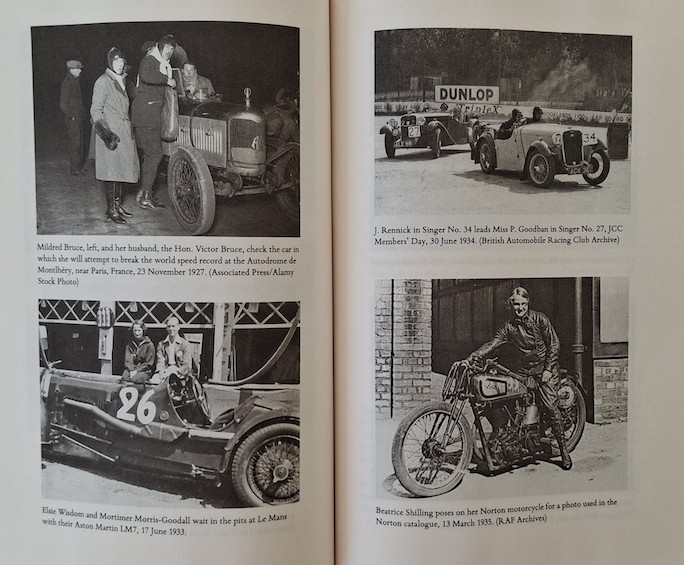
More Brooklands Belles including the intrepid Beatrice Shilling.
I was amused by the Barbara Cartland episode and spotted in the Bibliography that next to her entry was one for her even more famous British co-author Agatha Christie. There are no corresponding references in the Notes section and try as I might I couldn’t find any in the text either. Google suggests a link to a television adaption of the Double Clue Poirot whodunit filmed in part at Brooklands.
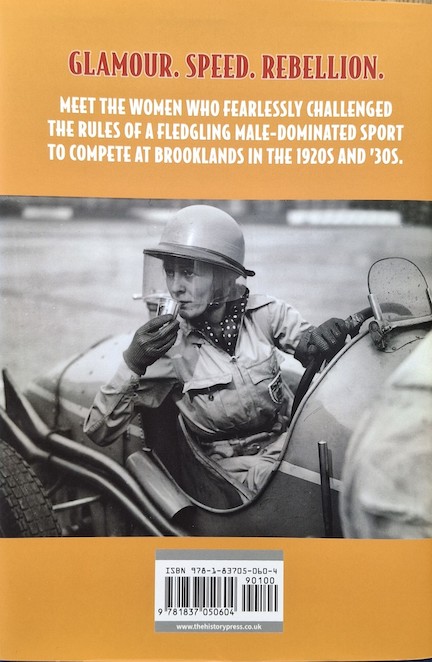 In summary this is in places an entertaining read and I am motivated to find out more about many of the Belles. But I did find the issues mentioned above made it hard going all too often. It is asking a lot to expect the average reader to “follow the plot(s),” especially those new to the topic who may have been attracted by the lurid front and back covers—”Glamour. Speed. Rebellion.”
There are between thirty and forty Brooklands Belles covered. There is no index and I wasn’t going to read it again to find out the exact number. The book would have immeasurably benefited from self-contained chapter histories of the main players, with a few more chapters covering the rest. And an index. Some of the material not directly linked to the Belles also might have been excised to make following the plot easier, especially in the “Brooklands Scene” chapter in descriptions of accidents and fatalities. Although to be fair it does mention women attending Brooklands. Content pertaining to other races and events would of course be “interesting” but readers should accept that the focus of the book reflects its title. There are plenty of excellent books on Brooklands history, not least by the aforementioned Bill Boddy.
Along with chapter restructuring, more resources put into prepublication reviewing and editing could have turned Brooklands Belles into an unreservedly good read fated to become a well-thumbed reference. The author’s enthusiasm is not in doubt; this is an inexpensive book that perhaps merits consideration.
The author comes from a family of car and motor-racing enthusiasts and his great-uncle raced at Brooklands. He has had a lifelong love of books and was managing director of The Folio Society where he launched the Folio Society Prize for Literature.
Copyright 2026, Paul Lea (speedreaders.info)









 Phone / Mail / Email
 RSS Feed
 Facebook
 Twitter