
Queen of the Midnight Skies
The Story of America’s Air Force Night Fighters
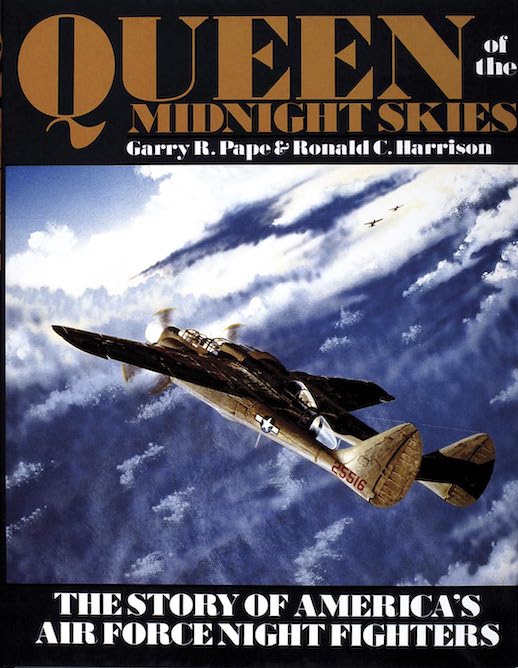 by Garry R. Pape & Ronald C. Harrison
“Though the main theme of this book is the story of the men who crewed and maintained these electronic flying machines, it would not be complete without the parallel story of those who developed and manufactured the radar and aircraft that would be melded together to produce the ‘night fighter.’’
As the opening quote indicates, unlike David Doyle’s book about the P-61, this volume is less about the airplane than the people in the squadrons who flew and maintained these airplanes and, as the opening quote says, prior to that the development of radar itself. Thus it should be no surprise that the first five chapters only discuss and describe how radar was initially conceived and developed.
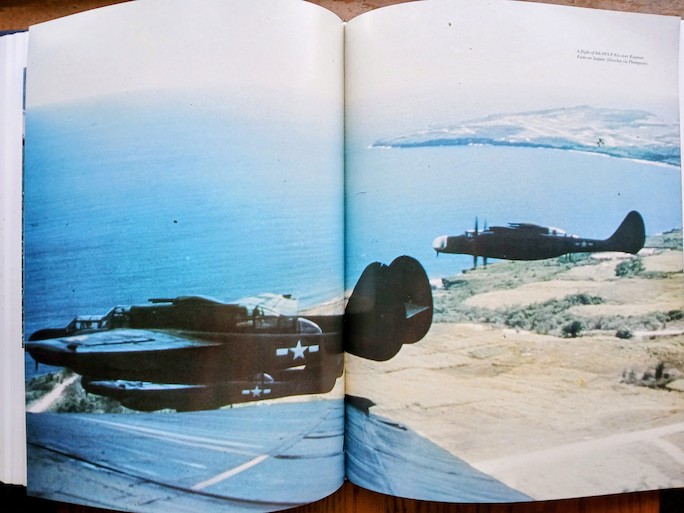
One of the page pairs in the 32-page color insert shows two P-61s aloft over Saipan.
The first readers see or read of the Queen of the Midnight Skies comes in the sixth chapter. Next are chapters about “the Lady in Black” one of which provides a tour of the night fighting systems and the abilities of the aircraft. A series of chapters follow organized by the different theaters of war and tell of the various squadrons situated in each.
Having lived with this book for a couple of weeks but only able to read in fits and starts, I realized that prior to reading of the men and activities of individual squadrons, it would be helpful to first spend some time familiarizing myself with the 14 pages of Appendix A.
The Appendix is appropriately titled “Operational Night Fighter Squadron Statistics.” In all you’ll find the statistics of twenty units. The pages shown below start on left with 417th, followed by 418th and 419th. The two emblems shown are, top, the 418th with that of 419th beneath it. The faces on facing page are “418th NFS ace team of 1st Lt. Philip B Porter (R/O) on left and Maj. Carroll C Smith (Pilot) on the right, with their aircraft at top and bottom right.”
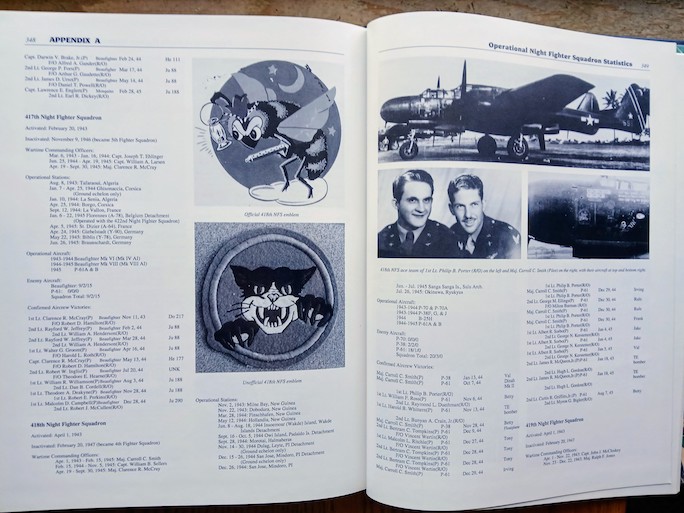
Two of Appendix A’s 14 pages that gives each Night Fighter squadron statistics. Readers get to fly along on several missions with the two men, pilot and R/O, shown.
The items listed in each squadron’s segment are dates when activated and deactivated, its commanding officers with the dates each led, Operational Stations with associated dates, the aircraft it flew, and the aircraft of the opposing forces it encountered and dealt with. Last are the names of “Confirmed Aircrew Victories.”
By the time you’ve familiarized yourself with the various squadrons and their achievements, returning to the text and learning of the men of the various squadrons in words and photos of the “Pacific Adventure,” then “Pacific Advance,” “Across the Atlantic,” the “Oriental Adventure,” “Roman Nights,” and the “European Engagement” and the similar-in-nature but different-in-details challenges each faced and how each coped is that much clearer reading of them all these decades later.
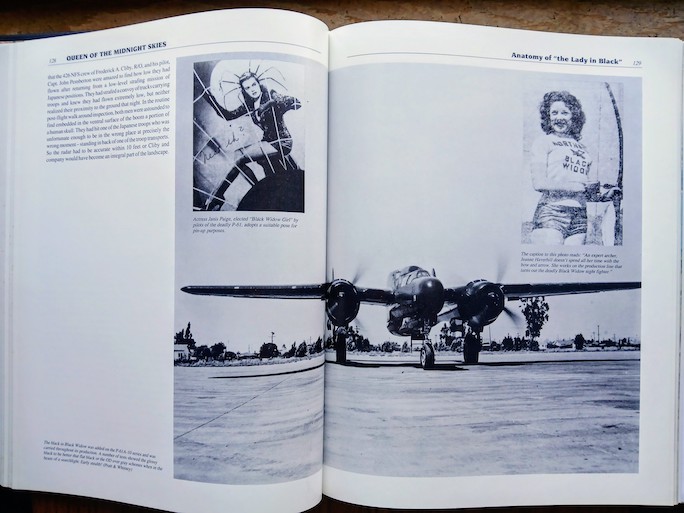
A Queen taxiing; left insert is an actress posing “for pin-up purposes.” Right insert is a lady who works on the Black Widow production line and also just happens to be an expert archer.
One of those challenges shared-in-common was the learn-as-we-go nature of their mission. Night fighting was new and so were the aircraft capable of successfully engaging the opposition. Fighter pilots “just couldn’t see how a fighter the size of a medium bomber could perform.” So John Myers who was Northrop’s Chief Engineering Test Pilot worked up a three-minute routine and took doubters for a ride. He “would make a very short take-off and climb up to a chandelle, back across the field at a very low altitude, loop right off the deck, then Immelmann. [Essentially a climbing half-loop, followed by a half-roll, coming out straight and level going in the opposite direction.] Coming out of the Immelmann, he’d feather the left engine, the critical engine, come down and across the deck again and do three rolls into the dead engine right off the deck and land.” Any who observed this routine or were along for the ride were doubters no more!
The book is filled with stories from each squadron in each theater. Numerous of them are told by the men who actually flew the missions because, remember, this book was published over 30 years ago and the authors had been able to find and interview many of those individuals directly as they make clear in their detailed acknowledgements. Others came from the annals of the squadrons’ preserved history.
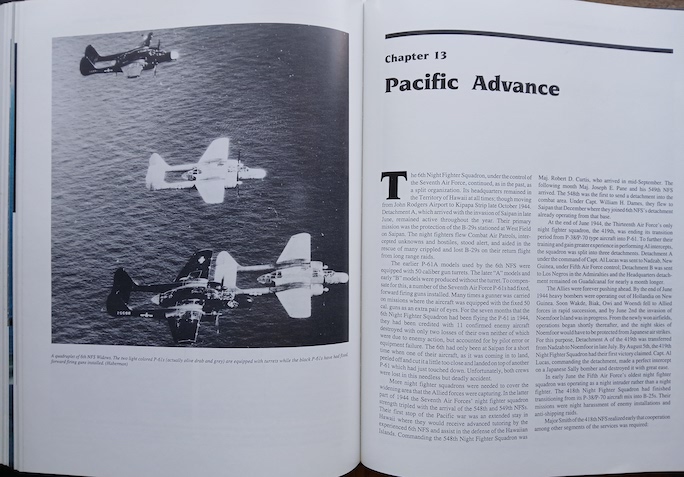
A quadruplet of Widows; two with turrets, two fitted with fixed, forward firing guns.
As the war wound down, one chapter is devoted to relating the ongoing development of P-61s that had been taking place including some of the flight experiences of Northrop’s test pilots—different in nature from those experienced by squadron pilots, but every bit as hair-raising. And throughout, there are the “unsung heroes” of the “engineering crews for keeping worn out airplanes operational without having proper support equipment or spares.”
To learn about the development of the Northrop P-61 Black Widow night fighters, find yourself a copy of David Doyle’s P-61 Black Widow, Northrop Night Fighter in WWII previously reviewed on this site. To learn the most about the development of radar itself and then meet the men who flew it and hear their stories of how the P-61s used it to help defeat the opposition in World War II, this Queen of the Midnight Skies is commended to you.
Copyright 2026 Helen V Hutchings (speedreaders.info)
 RSS Feed - Comments















 Phone / Mail / Email
 RSS Feed
 Facebook
 Twitter