
John Woolfe: The Man Who Bought a Porsche 917
by Ian Wagstaff & Dave Riswick
“John Woolfe entered the 1969 Le Mans race with a Porsche 917, numbered 10, to be driven by himself and Digby Martland. Martland met up with Woolfe in London. ‘He said, I’ve bought one of these’ and showed me the 917 in a catalogue!”
The more knowledgeable motorsport follower has not been served well by the mainstream film industry, and the Le Mans movies are no exception. Recent efforts have been the 2019 risible Ford v Ferrari that (very) loosely follows fact and Steve McQueen’s 1971 Le Mans that had no plot but plenty of glorious sequences of Porsche 917s. There were also lots of sequences of McQueen looking pensive, and that’s long before he had to internalize how poorly received the movie would be.
The real-life events of 1969 had plenty of drama. It had the closest ever contested finish, with the Ford GT40 of Jacky Ickx and Jackie Oliver beating the Porsche 908 of Hans Hermann and Gérard Larrousse by 120 meters. There was equal drama at the beginning. Ickx insisted that he would not join the traditional mad dash to his car at the start—he would walk, and go only when his seat belts were fastened. So he started dead last—but ended up winning anyway. John Woolfe like many of the others was likely in too much of a hurry to buckle into his brand-new Porsche 917. A few minutes later he was dead.
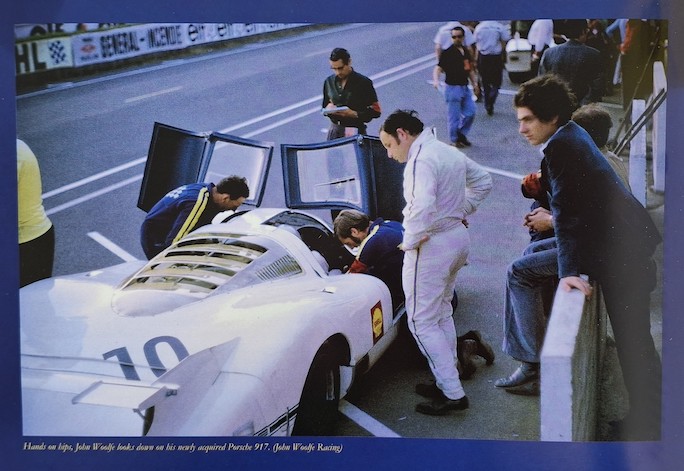
John Woolfe (c) contemplates.
The main narrative about Woolfe (b. 1932) has always been that he was out of his depth with that car and had ignored warnings from many other drivers not to race. The authors have set about discovering how Woolfe arrived at his final race, an intriguing story with a lot of new material.
Woolfe was born into what would be described as a middle-class family. There was enough money to employ a governess for him and his sister. The siblings and the governess were evacuated to the US in 1940, where Woolfe had his first exposure to the US/Californian lifestyle. In 1943 they returned to the UK (perhaps precipitately) with the last stage from Portugal to home being in a British Airways Sunderland flying boat.
There is not much noted about his subsequent upbringing, education, and employment. Early on he developed a taste for cars and motorsport. He started club racing in 1958 at the wheel of a Lotus VI and graduated to a series of more sophisticated (and faster) sports cars. One of these was a TVR Grantura which he raced at weekends and then used to “potter to my office in the City” every weekday.
He then dropped out of competing in 1962 “to concentrate on his business interests.” We are not enlightened as to the detail of these but when he returned to the sport in 1967 he had earned a great deal of money. He then acquired not one but two Shelby 427 Cobras, “one for the track and one for the road.” He had beaten Prince Rainier of Monaco to the sales; they subsequently became friends.
However he came by his resources, Woolfe was able to buy and campaign powerful cars. The Cobras were followed by a Chevron-Repco B12, Lola T70 Mk 3 GTs, a Ford GT40, and a McLaren M6B. He started racing at the international level and began to make a name for himself as being better than just a reasonably talented club racer.
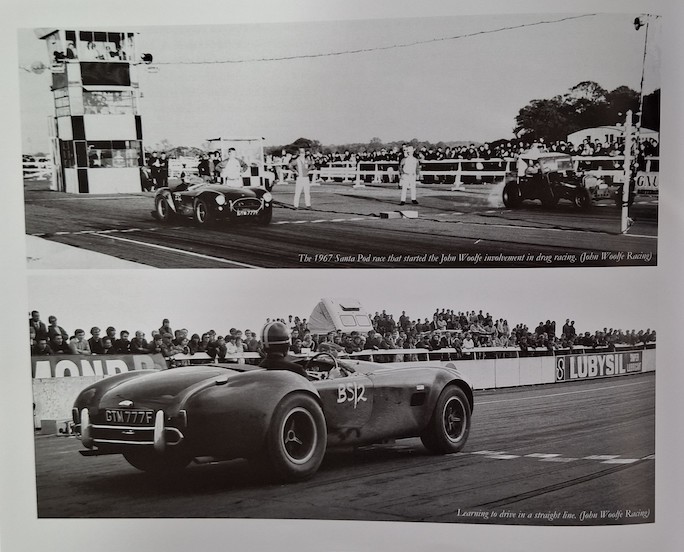
One of the Cobras was used for drag racing as well as on the circuits.
A chance meeting with USAF serviceman Dave Riswick (this book’s co-author) led to a passion for drag racing and subsequently a number of official World Records. It also led to the establishment of John Woolfe Racing, a company that has now been trading for over 50 years.
A key “what if” moment in the story of John Woolfe came early in 1969. His ownership of his McLaren M6B led him to place an order with McLaren for two M6GTs which he planned to race at Le Mans. A sudden change in homologation rules outlawed the M6GT so with plenty of cash in hand and a burning ambition to race a competitive car at Le Mans, he turned to Porsche and arrived at their factory with a check for £4,800 (over £100k/$125k today) as deposit for 917/005. Porsche had a serious cash flow problem having had to build 25 917s for homologation purposes and were happy to accept a privateer’s money.
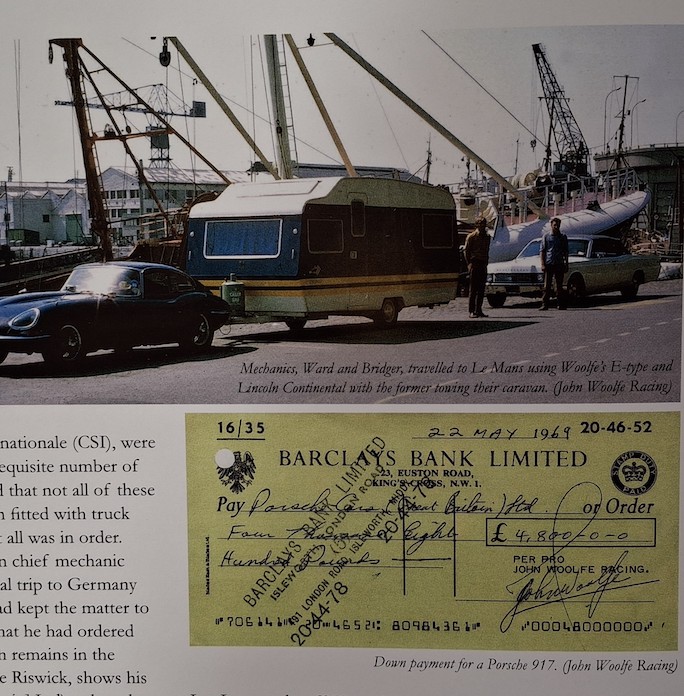
In 1969 £4,800 was the deposit for a potent race car
The purchase was only two weeks before Le Mans, when the 917’s second race, at the Nürburgring took place. All the factory drivers declined to drive it. After sufficient cash incentive was offered, David Piper and Australian Frank Gardner agreed and actually brought the car home in 10th place and, more importantly, in one piece. In this book Piper is quoted as stating the car handled like a grand piano with the lid up. More memorably (but not in the book) Gardner opined the car’s handling was like a leper in a swamp.
The first the Woolfe team saw of the car was when it was delivered to the final Le Mans practice, albeit it would be maintained by Porsche factory mechanics for the race. Ignition problems reduced running time and Woolfe never got to try the car with full tanks. He made a poor start so was in a hurry to pass slower cars. The outcome was not inevitable but highly likely. He had planned to retire from race driving at the end of the season anyway.
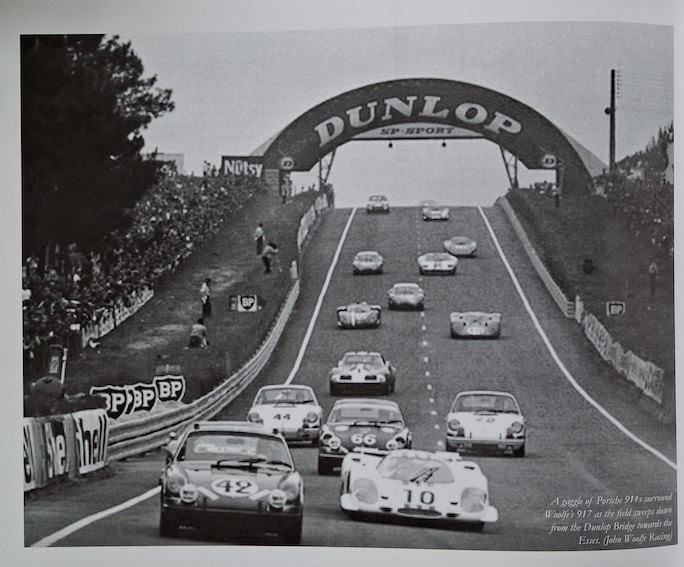
Making up for a poor start.
There has been a debate since then as to whether Woolfe was foolhardy to race the 917 given his lack of seat time in that model. A number of professional drivers including Vic Elford and Brian Redman tried to dissuade him. His supporters say that he was well experienced in handling powerful cars. In any event this was an era when motorsport fatalities were “a fact of life” and drivers accepted this. As to the 917 being undriveable, it is often forgotten in the excitement of the close finish that the Elford/Attwood 917 was leading by 6 laps before breaking down with a mere 3 hours to go.
Another what if. Woolfe had considerable talents as a motorsport correspondent. Had he lived, and continued to lead an eventful life, an autobiography would have been well worth reading.
A necessity for accuracy in writing history literature is to go to the original sources of information. This is not always possible when the original participants are no longer with us. But the authors have been able to quote from people still alive. Co-author Dave Riswick knows all there is to know about the drag racing events and history of John Woolfe Racing. Likewise the contributions of Digby Martland have corrected the “story” of his planned co-drive at Le Mans in 1969, not least repeated in the recent, otherwise excellent Against All the Others, Vol. 2 by Randy Leffingwell. Martland, an accomplished racer who had previously driven lower-powered cars, declined to drive the 917 after a frightening high-speed spin (he was replaced by Herbert Linge). Martland did NOT, as regularly quoted, walk away from the sport; he continued racing and was back at Le Mans the following year.
All followers of motorsport will likely regard their formative years watching as being “the golden years.” I am no exception. I count myself fortunate to have read about and attended events in the 1960s and 1970s when exponential change was taking place in designs and speeds. I also count myself fortunate that almost 60 years on, there continue to be new, well written books published that add to the record and better understanding. This book is one of these.
If you are a Porsche 917 aficionado, you will want this as a narrative of what it was like to be the first 917 customer; there are plenty of 917 images from John Woolfe Racing as well as the Porsche Archive. If you enjoy motorsports histories that break out of the repetitious event/car/average speed etc. reporting mode, this is also for you. Amongst the gems. Woolfe Racing was one of the owners of the legendary Fiat race car transporter subsequently used by Lance Reventlow, Carroll Shelby, Alan Mann, and Lotus. For some reason the Woolfe connection is rarely ever mentioned. (Surely the subject of a new book project for someone?)
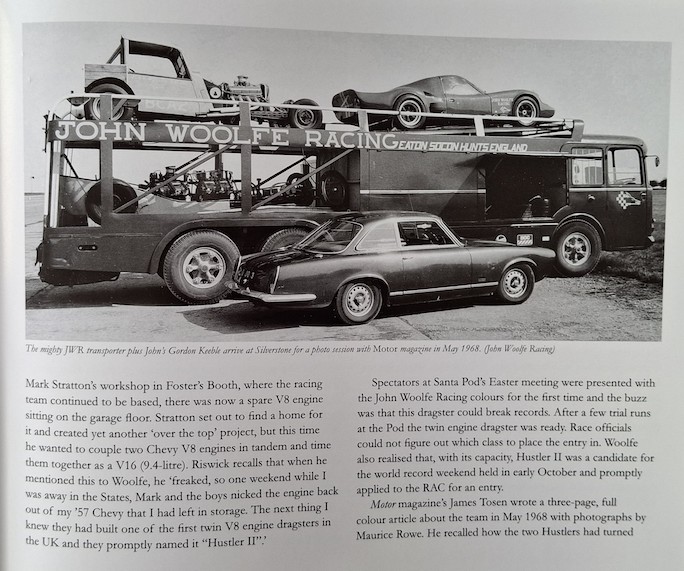
The transporter that subsequently went for £400k+ at auction.
A few anecdotes ought to be taken with a pinch of salt. His testing of one of his cars at 200 mph on the UK’s M1 motorway leading to the imposition of the 70 mph speed limit is likely conflated with the Willment Cobra/Jack Sears test run in 1964 at 183 mph which made newspaper headlines. The speed limit came into effect in December 1965, nearly two years before Woolfe acquired his Cobras which would have struggled to surpass Sears’ mark. This is quibbling—I thoroughly enjoyed the book.
There is a bibliography but no index.
Co-author Ian Wagstaff has written numerous motorsport books including the Haynes Porsche 917 Owners’ Workshop Manual and Porsche 917-02 in the Great Cars series by Porter Press. Co-Author Dave Riswick is Owner and Managing Director of John Woolfe Racing Ltd.
The book was published with the financial support of the Michael Sedgwick Memorial Trust which encourages the publication of new motoring research.
Copyright 2026, Paul Lea (speedreaders.info)



 Phone / Mail / Email
 RSS Feed
 Facebook
 Twitter