
Lee Noble, Supercar Genius
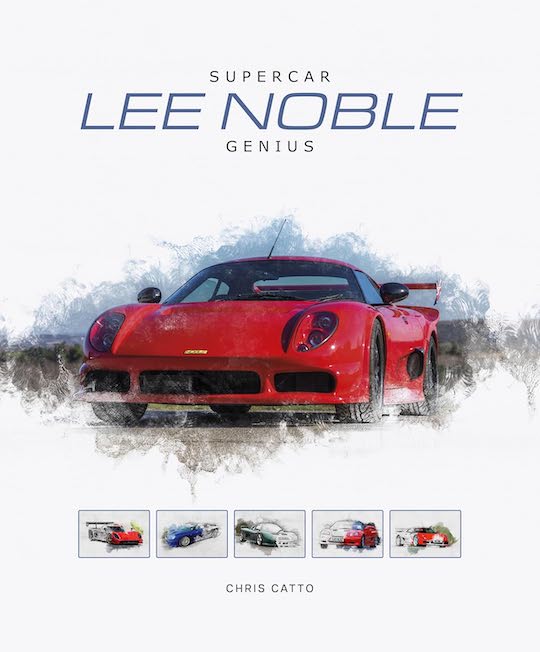 by Christopher Catto
“Make no mistake, you definitely should drive and enjoy any Ferrari, Lamborghini, McLaren, Porsche or Lotus: their abilities are well earned and respected. Noble cars, however, are not about showing off what badge and reputation you can afford, but about the thrill of living for each corner you approach.”
Those are some storied names. Can a near-unknown low-volume maker really hold its own in such company? That the author of a book about Noble cars should think so is no surprise but what if “Mr. F40” himself, Nicola Materazzi, feels that way? His engineering portfolio also includes the Ferrari 288 GTO, and the Bugatti EB110, and a large number of other go-fast machinery. He communed at length with the author of this book, which is dedicated to him, and he wrote a very fine and articulate Foreword but sadly died (2022) before seeing the book finished. Among many other pertinent observations he remarks, “I spent a lifetime working but also reading” and he so would have enjoyed adding this book to his collection because it is so well researched.
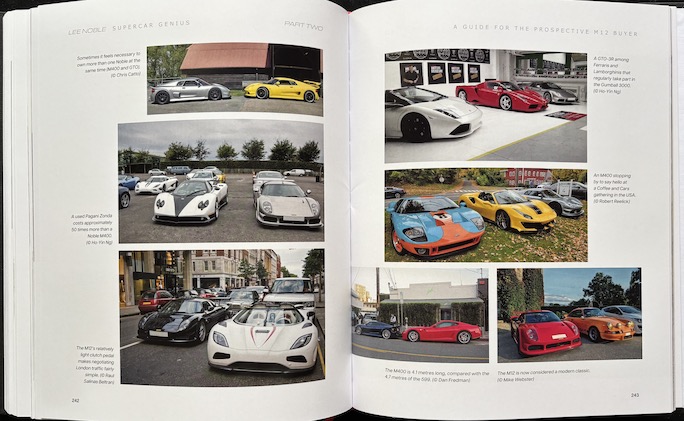
If you know your supercars you’ll recognize a bunch of marques here. The Noble M12 fits right in. You may well be shocked to discover how much less it cost even as it delivered as much if not more than its better-known peers.
If this is your first time making the acquaintance of British car designer and engineer Lee Antony Noble (b. 1958) be glad it’s in the form of a book this thorough. Not that there are (m)any to choose from . . . the occasional magazine article or press release was as good as it got.
Author Catto is singularly well suited to the task, being a trained and practicing motor engineer on the Vehicle Dynamics Development side with top-notch clients/employers including Cosworth, McLaren, and Rimac. Moreover, his first contact with Noble dates back to 2003 when he interviewed there for an internship during his undergraduate studies. While that didn’t pan out, Catto would later do design work for Noble “as a hobby.” The two share a specific dedication to engineering a car that demonstrates consistently competent handling at the limit of the performance envelope while remaining affordable to ordinary mortals. The aforementioned F40 is a case in point: it cost three or four times as much as a new Noble M12 or M400 but didn’t “do” more. No wonder Materazzi was impressed.
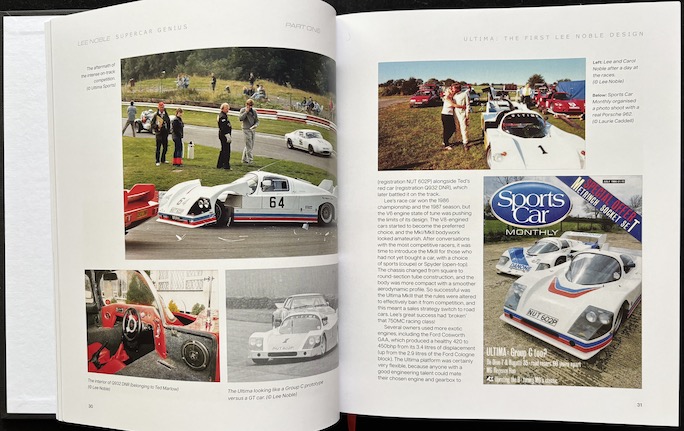
Just based on looks you probably wouldn’t guess that this is Noble’s first design.
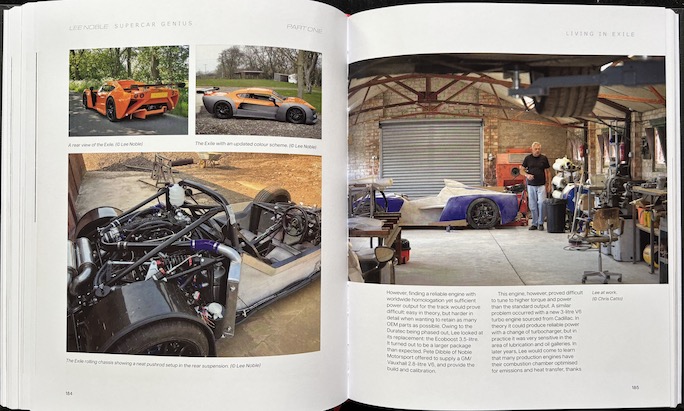
Decades later, the Exile model looks totally contemporary whereas the shop still looks much like it did in the beginning.
Given the paucity of Noble literature, Catto is acutely aware that all eyes in the Noble community are on him. Judging by the lengthy Acknowledgments, he had deep access to solid sources, not least Lee Noble himself who is still in the business although no longer connected to the company that builds cars that bear his name. Among the several interviews is one with him and it ranges from “fast cars” to “favorite music bands”. . . to “most useful advice”—which Noble, to his detriment, appears not to have heeded: “Get a decent job with a good pension!”
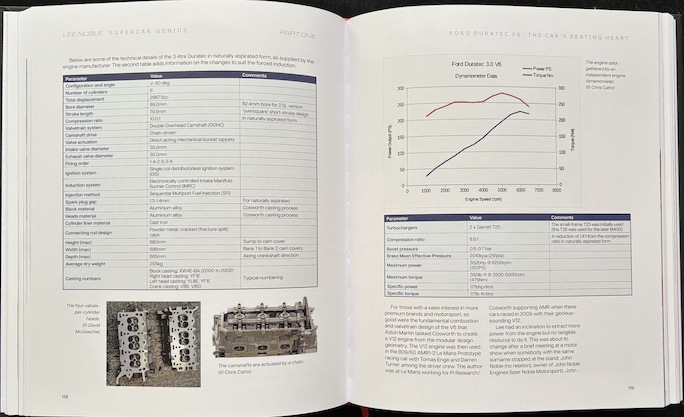
Just to manage expectations, this book is less model history (i.e. spec, trim, sales and such) or personal biography than an exposition of the available and theoretical technology. A biography of an engineer is by its nature a sort of hybrid. What begins as an easygoing exposition of early youth and formative influences (here in the form of imagined dialog, ca. 1970, between young Master Noble and his parents over a cracked-up model aeroplane) turns quickly enough into deep dives into technical concepts/principles with the occasional dip into, gasp, actual math (photo below) cf. formulae for spring stiffness, car handling being of such great interest to both Noble and Catto. If Pythagoras constant and motion ratio roll off your tongue easily, you’ll be right at home although thanks to Catto’s wordsmithing the book remains entirely readable at any level provided you actively engage—no daydreaming here, especially when it comes to maintaining awareness of where we are in the timeline because there may not be any dates mentioned for pages!
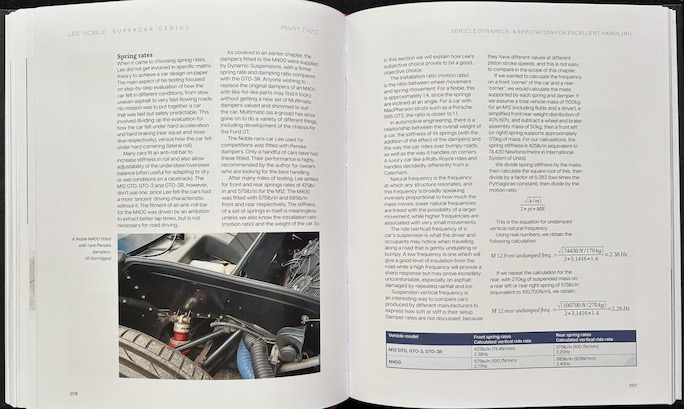
Catto’s goal here is to offer “a global knowledge base for anything and everything Noble” and the book connects all the relevant dots, down to even the practical level of real-life owner experiences—”Readers who predicted the author might brush all the horror stories under the carpet will be disappointed“—from driving impressions to reliability to running costs (UK sources for parts/service are listed).
A thorough Table of Contents and a somewhat high-level Index (in microscopically small print) help direct your inquiries. To say the obvious: if a 300-page book has to accommodate almost 600 illustrations you know that they can’t all be big.
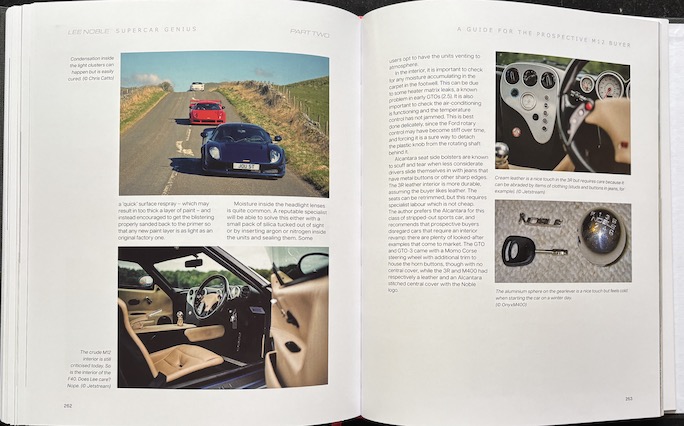
What level of detail is there? “The aluminimum sphere on the gearlever is a nice touch but feels cold when starting the car on a winter day.” (bottom right)
Copyright 2025, Sabu Advani (speedreaders.info)
 RSS Feed - Comments








 Phone / Mail / Email
 RSS Feed
 Facebook
 Twitter