
From the Royal Flying Corps to the Race to Circumnavigate the Globe
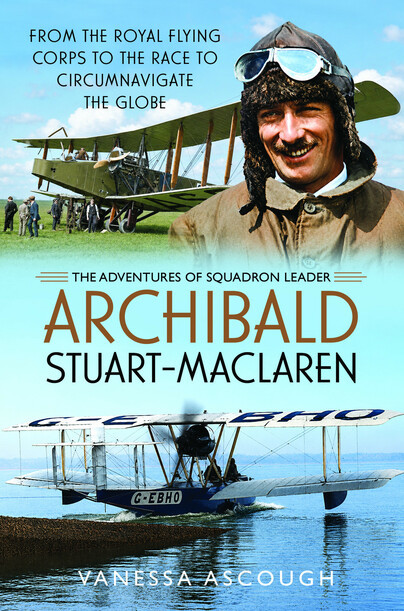 The Adventures of Squadron Leader Archibald Stuart-MacLaren
by Vanessa Ascough
“In the blinding rain, the pilot swerves suddenly, narrowly avoiding a cliff, and makes a last-ditch attempt to land. As he does so, both wingtips shatter, and the wings start to break up as he beaches the plane. The crew jump into the bitterly cold surf, struggling to hold the plane head on to the sea, as they contemplate the end of the British attempt to be the first men to fly around the world.”
Lump in your throat? Good. You certainly will have one after finishing this book, but for reasons that have nothing to do with that excerpt. If you don’t already know MacLaren’s story, savor the not-knowing and let the book do its work of weaving the strands together—because, once you know the end, you’ll never again see just the optimism, competence, courage and adventure but you will wrestle with the utter tragedy of the personal toll it all took.
The time of the above extract is, incidentally, 1924 so cast your mind back to an era that is almost indescribably different in every way from today, be it in regard to personal mores, untried tech, and a globe that still is mostly unconnected and foreboding. If you are an aviation historian you already know that many noteworthy events transpired in that era, and you may also know that even at the remove of a century we are still learning about especially the unsuccessful ones that received scant notice in period, especially when governments wished to suppress drawing attention to their own culpability in the outcome. In regards to the latter the mishaps surrounding No.1 Aerial Route RAF come to mind, and this reference is apropos insomuch as it involves the protagonist of this biography although it plays only a minor role here.
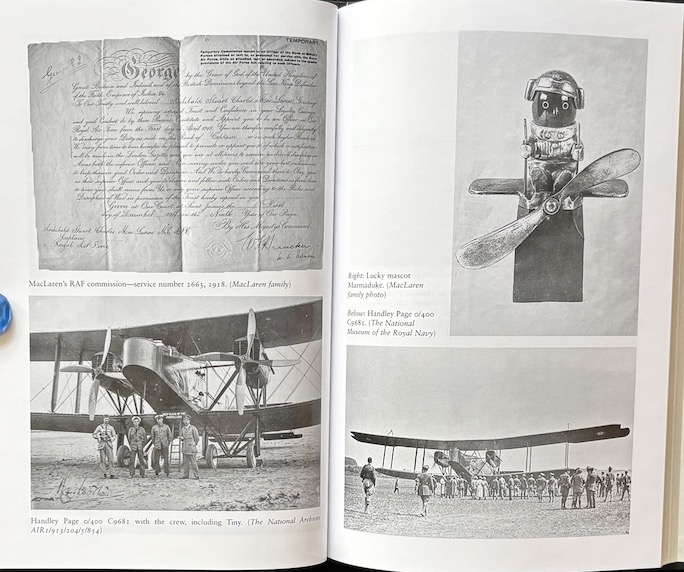
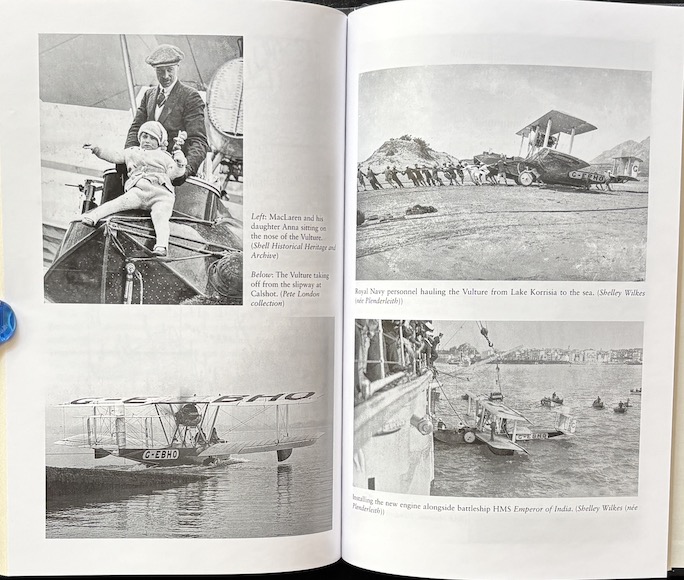
The Handley Page 0/400 heavy bomber, shown here, plays a big role in this book; the circumnavigation attempt involved a Vickers Vulture amphibian biplane (see the other two photos)—actually two because the first one was totaled in a crash, with the replacement aircraft being transported thousands of miles, in a gesture of supreme sportsmanship, by the competing Americans so the Brits could have another go. The paperwork said, “a free gift of America.”
The author is the granddaughter of Squadron Leader Archibald Stuart Charles Stuart-MacLaren OBE MC DFC AFC (1892–1943), a pioneering British aviator of note in his day. He died—too young—before she was born, and wasn’t much, but fondly, talked about in the family. While the book’s introductory remarks fill in some of the picture, it remains ultimately unclear what exactly set Ascough on the path of devoting years of her life to researching grandpa Archie, and then more years to presenting her findings to historical circles. What does matter is that her work “challenged [her] own thinking on so many aspects of life,” not only Archie’s but Life in general. How we cope with adversity, how to live a life of service and duty, what cost is too high in the pursuit of valiant goals. It is a big story—and it is a short book; for both reasons it invites attentive and sympathetic reading.
The book relates, in chronological order, all the pertinent stepping stones: family history, education, the spark of interest in aviation. For readers with big-picture leanings it will be useful to consider that MacLaren started his flying in the then three-year-old Royal Flying Corps—a corps of the army; the Royal Air Force wouldn’t be founded until 1918. MacLaren was a lackluster student at every stage and it is amusing to read that Winston Churchill once said about budding aviators, “We need not worry too much about educational tests. What is needed for this dangerous service is a young gentleman and a good animal.” Good thing MacLaren had a dog who liked to go flying!
Ascough drew on scrapbooks, diaries, action reports, correspondence, the recollections of the families of MacLaren’s two crewmembers on the ill-fated circumnavigation, and newspaper articles; she does lament “many gaps in service records.”
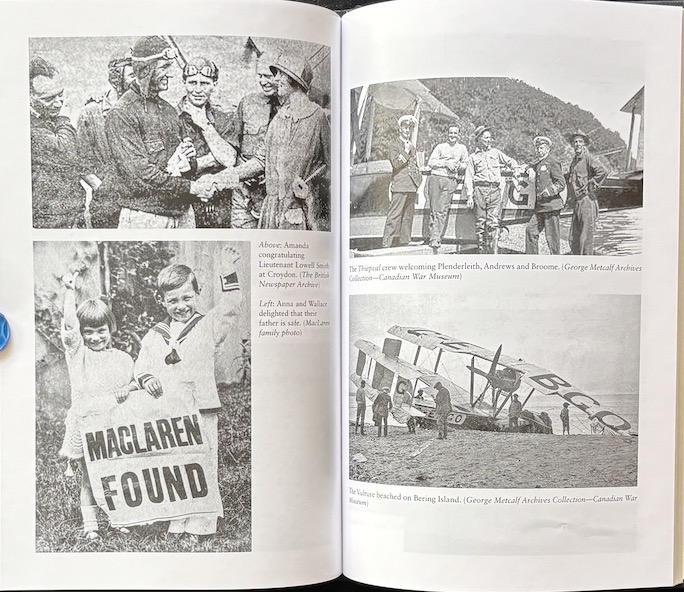
It’s not until the halfway point, chapter 9 of 18, that the story turns to the aerial circumnavigation part of the story, which transpires in the context of six concurrent attempts over the space of a few months in 1924 by Britain, the US (the winner), Portugal, France, Italy, and Argentina. It is now overdue to remark that the book has no Index (but there is a Bibliography, and numbered Endnotes) which makes integrating it into the surrounding literature difficult. For instance, the index of a key text on the aforementioned No.1 Aerial Route doesn’t list MacLaren at all. No matter, a clear enough picture emerges here, and, to return to an earlier point, one cannot fail to be moved by a man “who would in moments of confidence, discuss deeper subjects, and dilate on the psychology of flying, and the more advanced sentiments that lay behind the conquest of the air.”
Copyright 2026, Sabu Advani (speedreaders.info).





















 Phone / Mail / Email
 RSS Feed
 Facebook
 Twitter