
A Victorian Scientist and Engineer: Fleeming Jenkin and the Birth of Electrical Engineering

by Gillian Cookson and Colin A Hempstead
Admittedly, this topic is a bit removed from the field of transportation but electricity is an inseparable aspect of it. Moreover, there are not many books that shed light on the state of engineering or the education and training of engineers in the Victorian Age.
Spyders & Silhouettes: The World Manufacturers and Sports Car Championships in Photographs, 1972–1981
by János Wimpffen
A reader who went straight for the photos would be forgiven—they are the predominant feature of this and Wimpffen’s other three oversize and heavy books in this monumental series of photographic histories.
The Engines of Pratt & Whitney: A Technical History
by Jack Connors
The title of the book may not be showstopper but the book is commendable on all counts that matter to a reader: it is written in an uncommonly engaging style, introduces new material to the record, makes it easy for the reader new to the subject to develop an interest in it.
Art of the Formula 1 Race Car
by Stuart Codling (Author) & James Mann (Photographer)
Racecars have a purpose and that purpose is speed not beauty. But beautyis not the subject of this book, art is. Bandying these terms about sounds almost flippant but there are serious distinctions and they merit deep thought.
Peace was Their Profession—Strategic Air Command: A Tribute
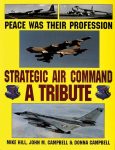
by Mike Hill, John M. Campbell & Donna Campbell
The title is derived from the Strategic Air Command’s motto “Peace is Our Profession” which insiders—who have earned the right—often amend to include “War is Our Hobby.” An alternate version is “Peace Through Strength—Victory Through Devastation.”
The Science of Formula 1 Design: Expert Analysis of the Anatomy of the Modern Grand Prix Car
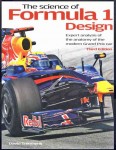
by David Tremayne
This book cleverly walks the tightrope of being both a technical book and one that will appeal to the reader who wants to understand more about the technology that goes into a modern Formula 1 car.
Jaguar, All the Cars
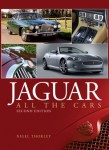
by Nigel Thorley
Thorley has written several excellent books on the marque. While past books have concentrated on specific models, this one covers the entire range of cars since the beginning, with a particular emphasis on postwar vehicles.
The Speed Merchants: A Journey through the World of Motor Racing, 1969–1972
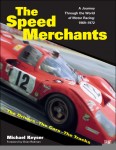
by Michael Keyser
Keyser tells the story of his involvement in some of the most high-pitched seasons of that time in motor racing, and he tells it from the rather unique perspective of photographer, driver, and filmmaker. All the storied people, cars, and race venues you’d expect are here.
Box Top Air Power: The Aviation Art of Model Airplane Boxes
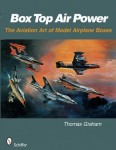
by Thomas Graham
This book presents about 170 examples of [a] “exemplary works” (in other words not everything under the sun) that [b] the author deems “artistically superior” (read: other people may have made other choices) of [c] predominantly US model kit makers (for European/Japanese kits look elsewhere).
American Military Vehicles of World War I
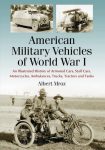
An Illustrated History of Armored Cars, Staff Cars, Motorcycles, Ambulances, Trucks, Tractors and Tanks
by Albert Mroz
For better or worse, war, or even the prospect of war gives rise to a degree of need and sense of urgency that accelerates development of whatever tools are deemed necessary to gain supremacy, be it throwing rocks at each other or splitting the atom.
American Cars, Trucks and Motorcycles of World War I
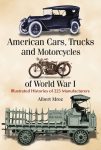
Illustrated Histories of 225 Manufacturers
by Albert Mroz
A basic perspective on this specific time period, not to serve as an in-depth model history or any one maker’s entire model range. Even with this intentional brevity the text consists of fully articulated sentences and is quite detailed.
Route 66: The Empires of Amusement
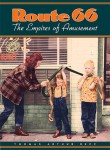
by Thomas Arthur Repp (Photographer)
It is reassuring to note that Repp’s book was received positively by the inner circle of established Route 66 writers such as Michael Wallis or Jim Ross. Sort of like going to an ethnic restaurant and seeing “natives” there. Presumably they know what’s what and their presence legitimizes the joint.




 Phone / Mail / Email
 RSS Feed
 Facebook
 Twitter