
Le Mans 2000–09, The Official History of the World’s Greatest Motor Race
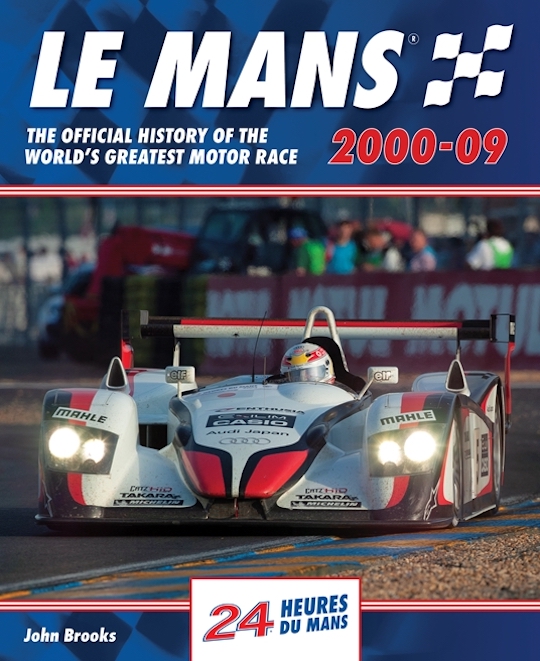 by John Brooks
“People often ask me what I love most about Le Mans. The answer is simple: all of it . . the victories were simply icing on the cake”
—Tom Kristensen, nine-time Le Mans winner
“A race for the English organised by the French.”
—Michel Cosson, Automobile Club de L’Ouest
If Robert Kubica and his pals Yifei Ye and Phil Hanson had stowed this book in their AF Corse Ferrari 499P on race weekend I don’t think they would have won Le Mans. They’d have had something to read down the Mulsanne Straight but the sheer avoirdupois of John Brooks’ 416-page work would have screwed the ACO’s Balance of Performance prestidigitation. Le Mans: The Official History 2000–09 spans the years of Audi’s hegemony, Tom Kristensen’s winning streak, Bentley’s return from the grave, and the apogee of diesel power in endurance racing.
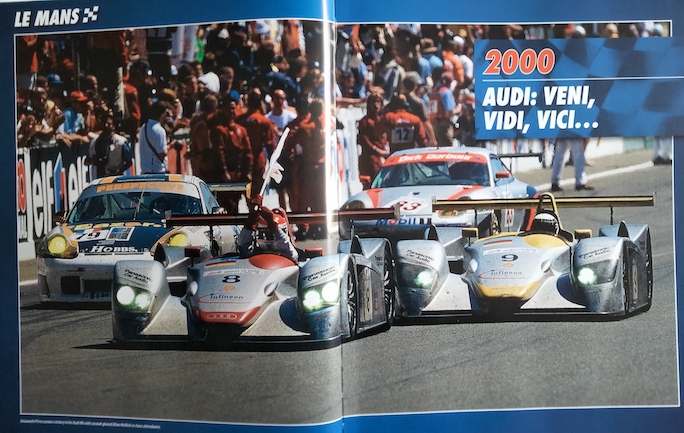
A Latin-flavored win for Audi—Pirro and McNish in their R8s.
If you want to know what happened at Les Vingt Quatre Heures du Mans during the first decade of this millennium it’s all here, look no further. There’s forty pages of fact-drenched text to digest for each year and, unlike some racing histories, this book doesn’t just talk about the winners. If you are racking your brain to recall when (or even if) some guy called Adrian Newey ever raced at Le Mans and, if so, in what year, one of John Brooks’ tables tells you. The man with the golden pencil (ask March/Williams/McLaren/Red Bull, and maybe Aston Martin) is just one of the 500+ drivers listed here, having finished 22nd in an AF Corse (yes, them again) Ferrari 430 in 2007.
Le Mans is the most famous road race in the world and constitutes one prong of the Triple Crown, alongside the Indianapolis 500 and the Monaco Grand Prix. There have been many pretenders for the crown, notably and recently including Fernando Alonso, but there’s only ever been a single monarch—Norman Graham Hill. But anyone racing at Le Sarthe does so in the metaphorical tire tracks of previous victors, from Woolf Barnato via Mike Hawthorn and AJ Foyt to Jackie Ickx and Yannick Dalmas. And in the very literal tracks of Tom Kristensen in—count ’em—seven years of the decade covered here.
The author made his first pilgrimage to Le Mans in 1978 and hasn’t been able to stay away since. He’s been active in the motorsport world for decades as a writer and photographer but this is his first book. Not only did he write the words but he also took all the 500 pictures. I approach the word “definitive” with the same hesitancy I’d apply to an argument with Jos Verstappen, because getting it wrong can have consequences. Le Mans has a serious fanbase and there’s scores, no hundreds, of books about the great race. I’ve never even been to the race (it’s 20 hours too long for me) but I have already reviewed three Le Mans-themed books here. But no equivocation, this book richly deserves the acclamation of the D word. Its deep dive into the minutiae of each year’s race, the comprehensive list of competitors, and the informed commentary of the great race’s infrastructure and organization is going to sate even the most voracious appetite.
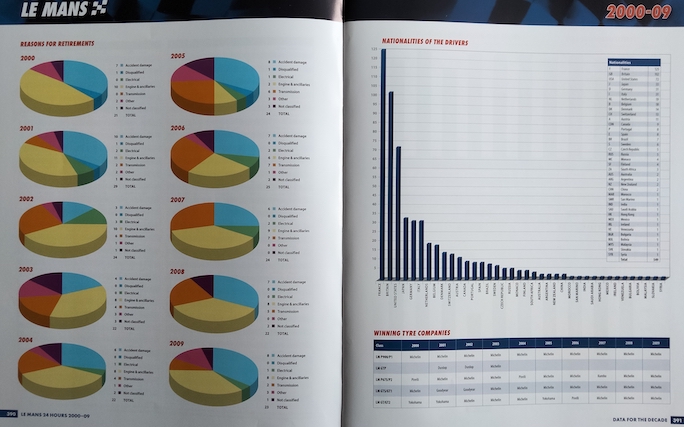
“Why our Le Mans dream ended in tears 2000–2009.”
Apart from the forensic analysis of each year’s race, I enjoyed learning about the politics underpinning the event. Rule change and refinement, track alterations, and car specifications were the choppy waters competitors had to navigate each year. There’s the relatively obvious stuff, like the external LED displays in 2007 and the arcane, such as the requirement in the same year for race cars to be fitted with sensors to monitor cockpit temperatures. And what would Innes Ireland and Mike Hawthorn have made of that? The book nominally covers a specified decade but earlier events aren’t ignored, not least the legacy of the airborne Mercedes CLRs in ’99. Nobody has forgotten the 1955 disaster, also involving Mercedes, and from today’s perspective the decision to race the flight-prone CLR seems a foolhardy temptation of fate.
I was struck by how the ACO is aware of its responsibility as trustee of the event’s unparalleled legacy—from the Bentley Boys to the Porsche 956 years—but isn’t reluctant to explore and embrace innovation and change.
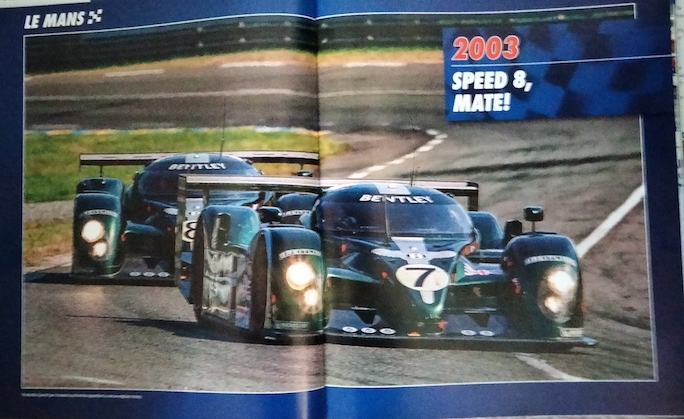
The 2003 season chapter stars the New Bentley Boys, inevitably including Tom Kristensen.
And there was plenty of both in the years spanned here . . . despite the best efforts of Drive to Survive (and probably the forthcoming F1 movie) motorsport, especially endurance racing, isn’t just about the winners. In fact, despite the near cargo cult adoration of Steve McQueen’s Le Mans isn’t even really about the drivers. Max Verstappen won the world drivers’ championship last year, but nobody except McLaren’s accountants cares very much about who won the constructors’ championship. But it was Ford who won Le Mans in 1966 and, until that silly movie, you were hard-pushed to find anybody who thought that Ken Miles had been the victim of a Motown conspiracy.
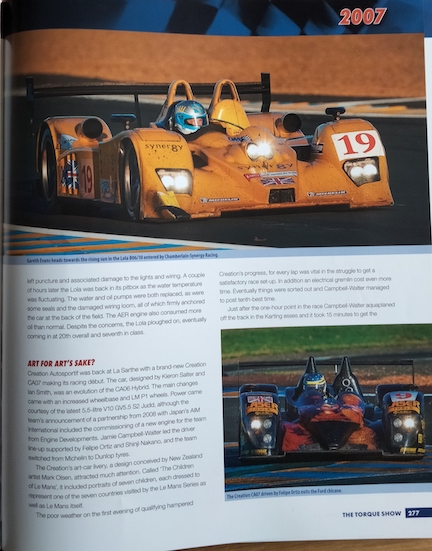
Gareth Evans en route to 20th place in his fleet-footed Lola B06/10.
I admire how Brooks doesn’t neglect the also-rans, the has-beens, the brave and the broke, and I enjoyed reading about the losers and no hopers. Savor the tale of the doomed Japanese Lamborghini Owners’ Club Murcielago R-GT LM in 2009. It retired after the first lap. What about the fleet little flyweight racers—the MGs, the Pilbeams, the Lolas—and the heavy metal kids, the thunderous Panoz and ‘Vette? And who even remembers the rara avis Pagani Zonda from 2001?
This an easy book to digest as it’s broken down to short paragraphs devoted to key facets of each race. The author has enjoyed himself with some smart-arse subheadings here, nicely seasoning some fact-heavy text with knowing whimsy. Anyone who can sneak in a Joni Mitchell quote is just fine by me (Dreams and False Alarms, from Amelia, my second favorite song on Hejira).
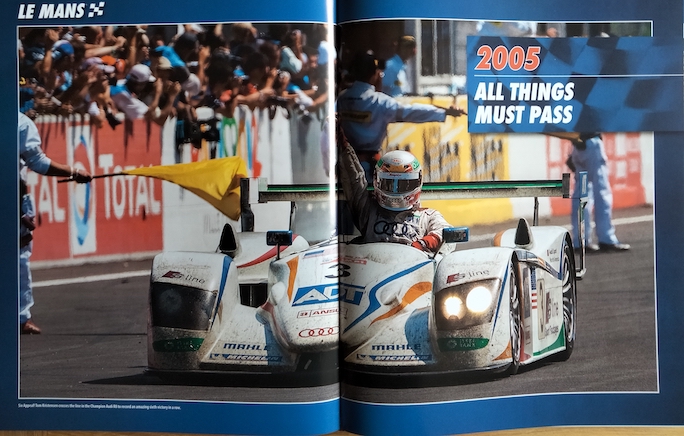
2005 was a George Harrison year.
So, no nits to pick then? I do have one, and it’s the pictures. Just as in Jutta Fausel’s recent Formula 2 book there’s no shortage of shots depicting the race cars, but the price paid for the inclusion of so many tightly focussed on-track shots is the scarcity of pictures depicting Les Vingt Quatre Heures as theater. It is one of the most photogenic circuits and the book would have benefited by the inclusion of more atmospheric shots.
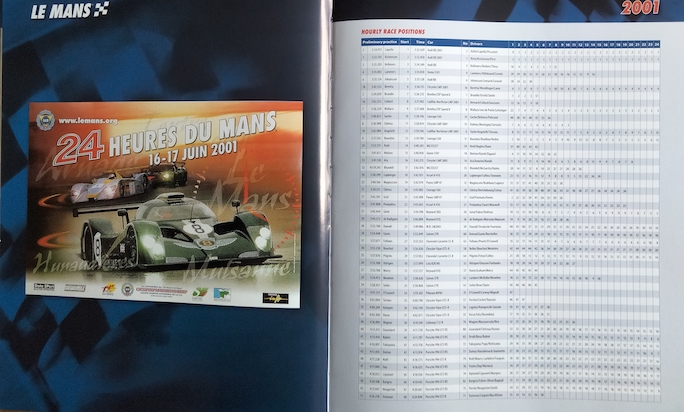
The ACO poster for the 2001 race featuring the Bentley Speed 8 is a welcome contrast to race car shots.
I’d love to have seen some misty-dawned views down the Mulsanne, battle-worn spectators’ morning-after tristesse, and the thousand-yard stare sported by grimy mechanics trying to nurse a damaged car through the next thousand miles. This book is primarily one of record but I’d like to have seen more space devoted to the inherent drama of a 24-hour race watched by a quarter of a million people.
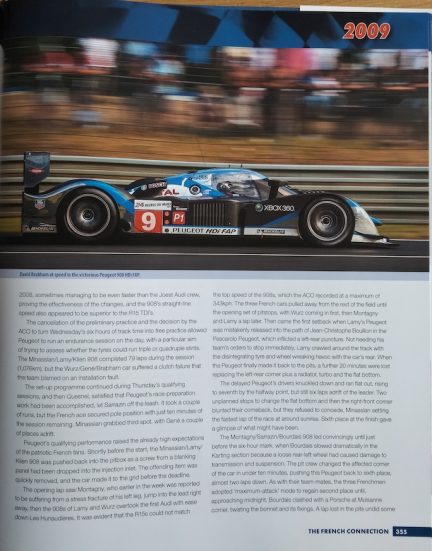
The swoopy Peugeot 908 with David Brabham on his way to glory.
The book is about the Audi decade, when generations had passed since Auto Union (which evolved into Audi) had dominated prewar Grands Prix, as one half of the ur Silver Arrows double act. C’est magnifique, mais ce n’est pas la guerre is the phrase that might be repurposed to describe Audi’s dominance. But hubris has a nasty habit of pooping the party, and the triumph of Audi’s diesel might (winning in 2006–08) was eclipsed by Volkswagen’s dieselgate scandal within a decade. Peugeot, along with VAG the master of diesel-powered road cars in Europe, also won with its 908 HDi Fap V12 in 2010, but diesel cars are fast on their way to automotive dodo status in 2025.
I know, I know, I’ve strayed from the point. Again. But good books make you do that—and this is a very good book. I recommend it whether you’ve been to Le Mans or are just a dilettante, like your reviewer.
Copyright John Aston, 2025 (speedreaders.info)
 RSS Feed - Comments










 Phone / Mail / Email
 RSS Feed
 Facebook
 Twitter