
Lotus Europa, Colin Chapman’s Mid-Engined Masterpiece (Reprint)
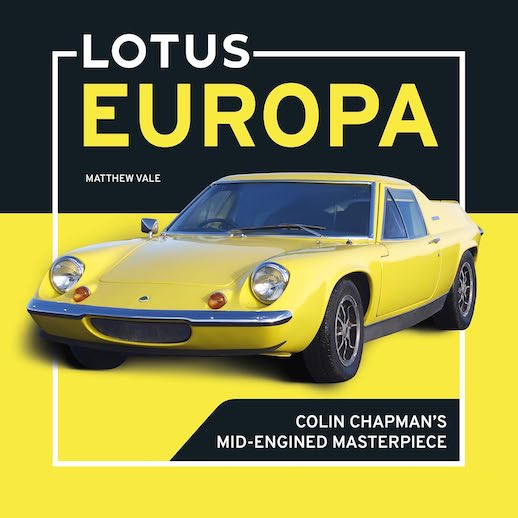 by Matthew Vale
“You’ve got today, tonight, tomorrow and tomorrow night – that’s four days; plenty of time.”
—Colin Chapman, explaining the 14-day working week to Mike Kimberley (Lotus engineer / MD/CEO)
The book cover looks like it tells you everything you’d need to know—except it doesn’t: it is missing the critical clue that you may already have this book, seven years older, with a different cover, and a different ISBN. This is a straight reprint, which will frustrate anyone who was hoping that the exceedingly scant Europa literature was here expanded. And it will definitely frustrate anyone doing a literature search in the future. On the upside, the price went down, from $65/£40 in 2019 to $29.99/£25 in 2026 although this is not an apples to apples comparison as the reprint is “only” a softcover.
Even though the contents of both versions is the same we feel sufficiently motivated to throw a whole new review at it:
IF THE LOTUS Elan was the pretty girl next door, the Europa was her kooky cousin, the Lisa Kudrow to her Jennifer Aniston. Both cars were baby boomer toys, but it is the Elan that enjoys the higher reputation, both now and already in period. Everybody loves a Jennifer, but what would your folks make of a Lisa? And while Lotuses (never Loti) don’t command the astronomical prices of their aristocratic rivals from Stuttgart, Milano and Maranello, the price of a well-restored Elan will raise the eyebrows of anybody who bought one in the Sixties. They were never cheap, 40% more than an MGB, but neither were they expensive, just half the price of a 911. TV stardom helped, and I’m not sure whether I fell in love with Diana Rigg’s Emma Peel or her Elan dhc first. Her successor, Tara King (played by Linda Thorson), did drive a Europa S2 but they didn’t make my heart race like Ms Rigg and her steed (sorry). Northern Ireland football legend George Best, no stranger to the gossip pages, was the other famous S2 owner, but it was Best’s leggy companions who stole the scene from his yellow Lotus.
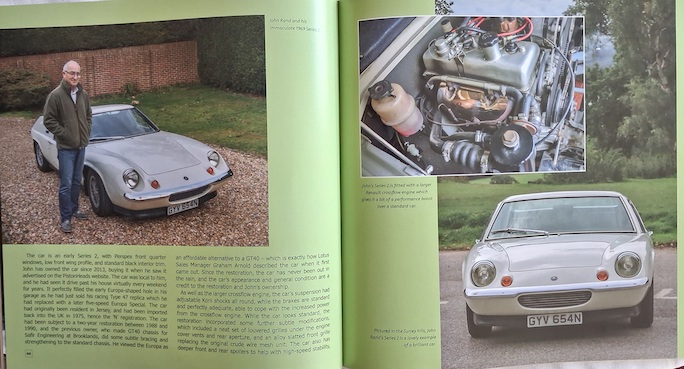
One of many proud owners in the book.
But the Europa deserves more than footnote status, and this 160-page softback provides a detailed account of the mid-engined Lotus’ genesis and evolution over its nine-year lifespan. However, the book’s principal appeal is to potential owners of the car which ceased production over half a century ago. The Europa evolved from the modestly powered Series 1 with a 1470 cc Renault 16 engine to the much more potent Lotus twin cam, a major hike in power from 78 bhp to 126 bhp. As an aside, how remarkable it seems that a mid-engined sports car from a Formula One World Championship-winning marque boasted less than 70% of the power of my sister’s Toyota Yaris hybrid. But, as the author reminds us, before the advent of mandatory (and heavy) safety systems of modern cars, Lotus could make a slippery 700 kilo featherweight with the performance to escape sand being kicked in its face by its European competition. ‘Vettes and Mustangs? Not so much, except on a twisty road …
Three of the book’s six chapters are meticulously researched descriptions and general characteristics of the Europa’s three generations—Series 1, 2, and Twin Cam/Special. The Europa evolved from stripped-down “form defined by function” sports car (lacking even opening windows in Series 1) to the positively bourgeois final versions, with the showroom appeal of electric windows and glossy wooden dashboard.
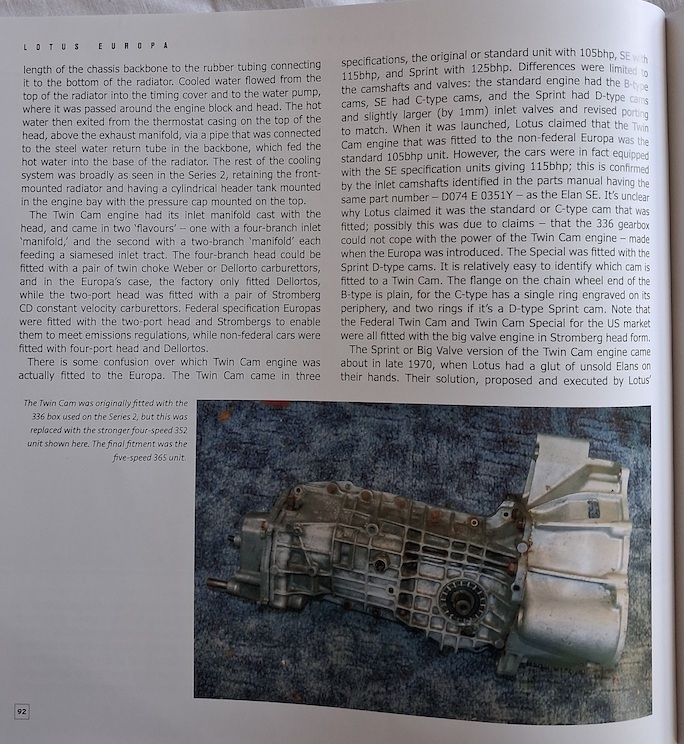
You want detail? Check.
The text is supplemented by lots of pictures, with subjects ranging from smiling owners with their gleaming cars to the sort of microscopic detail a restorer might need. Pedal box, master cylinders, sill extensions? It’s not exactly eye candy but your hunt for enlightenment may be over. Due diligence on potential purchase needed? This book will even give you the part number for the radiator fan for a Series 2 (046 M6124, since you’re asking), and remind you that twin windshield wipers were only fitted from chassis #1457. Look, if you’ve decided you want a Europa in your life you’re going to need this book, perhaps to supplement the other titles on the same subject, including the author’s own Essential Buyer’s Guide (2018).
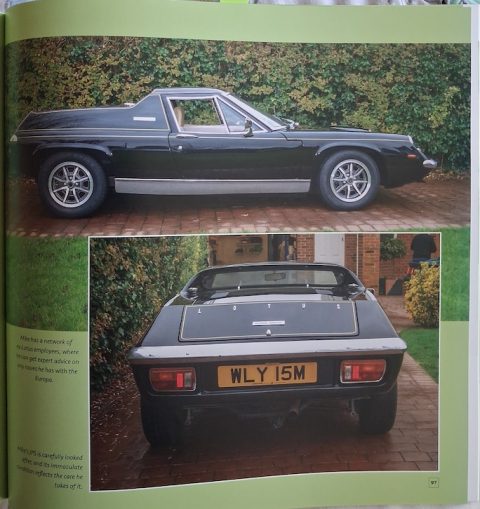
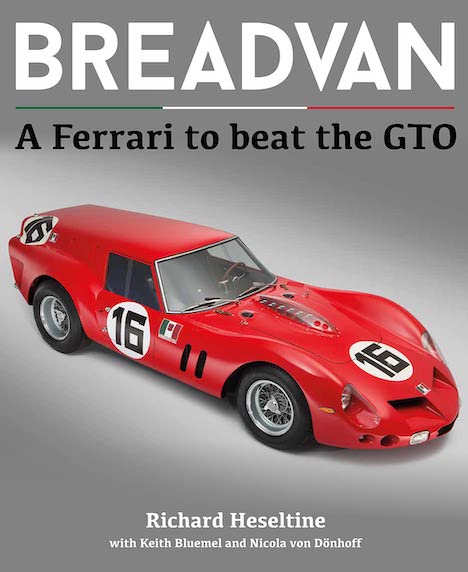
“Breadvan” Twin Cam Special in Lotus JPS livery.
But I have some criticisms, starting with the pictures.
Almost all are from later times, often taken in owners’ driveways or at car shows, and I’d have liked to have seen some period pictures from back when the Europa was disrupting the sports car status quo. The book’s appeal would also have been broadened if it had included much longer extracts, or even full reproductions of contemporary road tests. As it is, there’s a short extract from Denis Jenkinson’s journey to the Targa Florio in an early Europa, and quotes from CAR magazine’s LJK Setright and Doug Blain (not “John Blain,” as mistakenly stated, and referring to the arch-iconoclast Aussie as a mere “tester” does him a disservice). Copyright issues might have made full reproduction of tests expensive, but not to have included a full set of performance figures (just the inevitable 0–60 mph) seems like a missed opportunity in such an otherwise detailed work. It also would have provided context to the Europa’s standing in the Pantheon of 1960s sports cars. Obvious competitors would have included the MGB, Alfa Romeo Duetto, and Fiat 124 Spider but the biggest threat came from—you guessed—its older sister, the Elan.
The book’s primary appeal is to actual and potential Europa owners, rather than students and admirers of Colin Chapman’s legacy. But the book does have some interesting anecdotage, including stories told during the author’s lunch with Lotus illuminati Mike Kimberley and Oliver Winterbottom. I enjoyed the description of the encounter with Hollywood royalty James Stewart, who was visiting the former RAF Hethel, his wartime base (“You probably remember me more as a cowboy than a pilot …”) Unlike silver screen tough guy John Wayne, Stewart had a distinguished war record, serving as a decorated colonel in the US Army Air Forces.
The book is written in an accessible, demotic style and I easily read it in a single sitting. I’ll own up to skipping some of the gnarlier detail but I enjoyed reading about the Europa’s competition record and positively savored the account of GKN 47 (its full registration number is actually GKN 47D).
On track, the Europa is still a relatively common sight in British Historic racing, if not as ubiquitous as the Cobra-slaying Elan 26R. The Europa’s real glory days were in 1970s production sports car racing, when I saw perma-tanned local playboy Chris Meek dominate many races in his Twin Cam. But why had I almost forgotten GKN 47, the one-off V8-powered variant that was one of Lotus’ biggest missed opportunities? In the ‘70s, Colin Chapman’s plan was to take Lotus upmarket with the more opulent Type 75 and 83 Elite S 2, and later with the Europa’s mid-engined successor, the Esprit. But although the sexy new Lotuses talked the talk, they struggled to walk the walk with the underpowered in-house Type 907 engine. Even the turbo Esprit (from 1982) and the new Type 918 V8 in 1996 weren’t good enough to tempt many customers away from their flat six 911s and V8 TVRs. And yet the 1975 GKN Europa had already shown a better way forward. How bizarre it now seems that only Morgan, purveyor of Jurassic-era roadsters to tweedy gentlemen, had seized the opportunity to use the potent and lightweight Rover (neé Oldsmobile) V8 in 1968. TVR, Ginetta, Triumph and Marcos took another decade to twig, while MG failed properly to exploit the V8 in the MGB in 1973. A Rover V8-powered series of mid-engined Lotuses would have transformed a merely brisk car to a nailed-on supercar. Not for the first time, the British sports car industry dropped the ball. But be grateful for small mercies—at least we avoided the prospect of the next Europa looking like the hideous Europa GS. Imagine the consequences of a one-night stand between a Lancia Beta Monte Carlo and a TVR Tasmin … one look and you’d have put it up for adoption. Trigger warning: avoid page 146, below.
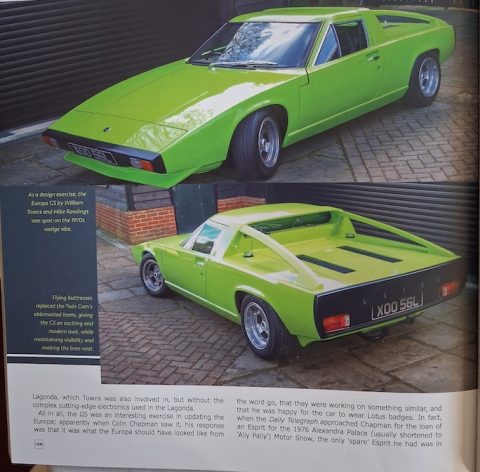
Europa GS. Look away now.
This modestly priced book is an absorbing and thorough guide to the Europa, especially from the perspective of a potential owner. You will also find some useful discussion of the Lotus marque, particularly from the production car perspective, but you need to look elsewhere for the full story of Colin Chapman’s extraordinary legacy. I’d recommend Karl Ludvigsen’s masterful Colin Chapman: Inside the Innovator (2011 and 2021). But for under $30 this book is as much a bargain as its subject.
John Aston, speedreaders.info, May 2026












 Phone / Mail / Email
 RSS Feed
 Facebook
 Twitter